Office Desk, 2040
Abstract [TL;DR]
This project, in collaboration with law students, imagines a 2040 “age‑agnostic” India in which older adults retain cognitive and physical capability on par with younger generations, supported by neurotechnology, assistive exosuits, and VR workspaces. Framed through causal layered analysis of present-day elders’ social isolation, digital exclusion, and shifting notions of respect, it explores how law, policy, and design might collaboratively restore seniors as vital contributors rather than dependants. The team used AI-assisted secondary research for PESTEL signal searching and speculated probable, plausible and possible futures through laddering and scenario mapping and created a justice manifesto. The speculative prototype reconstructs the desk of a post‑retired construction officer, featuring smart VR glasses and an assistive robotic exosuit hand and a formalised post‑retirement scheme with guaranteed benefits and a voice in policy reform.
Is your grandpa more of a banyan tree or a tortoise?
Not a question we began with, but certainly one we left with. If you're given a design brief to imagine the most optimistic of futures for the elderly and forget all implementation challenges ever and do it in a team of 9 people (comprising design and law students), it would feel daunting to say the least. To understand the landscape first, we conducted a causal layered analysis for our stakeholders (the elderly) from 2025 to 2010. We looked at emerging or evolving trends, news articles, research articles, cultural responsibilities and changing aspirations.
Our faculty advised us to use metaphors for the elderly to help people connect to their situation from both decades. For 2010, we chose a banyan tree that grows and supports the ecosystem around it, becomes a key part of the ecosystem, and whose loss would affect the whole forest. By 2025, they have become more of a turtle, who take their time to slowly adapt and distance themselves when they are rushed.
Gerontocratic veto powers are blocking structural reforms, particularly systemic or fiscal changes.
Hands-free human-machine-interfaces built for older adults and people with physical disabilties.
Older adults are consuming less and producing smaller carbon footprints than younger individuals.
Elderly households are spending more on health care, causing financial distress in daily needs.
As joint families dissolve and nuclear families grow, old family arrangements are shifting.
reveal
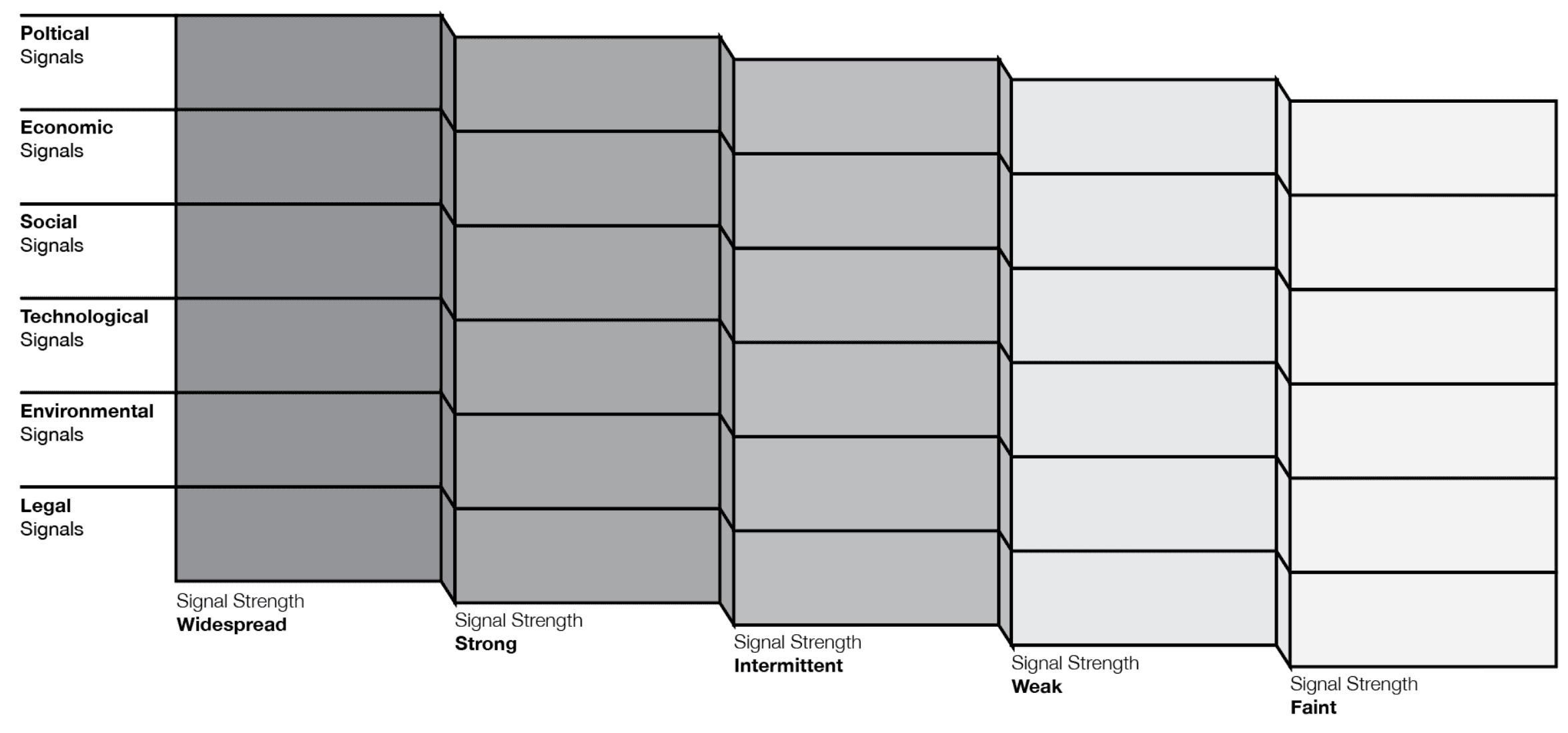
Drag and drop to guess the type of signal and its strength!
After framing multiple such PESTEL signals, we mapped them out on positive and negative futures on the basis of their possibility, plausibility and probability. These led us to our insights that would lay the groundwork for the 2040 future.
Increasing discourse against ageism in voting systems is affecting the degree of political influence and participation of older citizens, which is evident in how state governments design pension and social contribution programmes to prevent exploitation.
POLITICAL
In elderly households, healthcare costs often end up becoming unaffordable due to gaps in economic safety nets. This results in limited access to essential services, increasing financial strain. These challenges are further intensified by gender disparities, insufficient family support, and the absence of reliable state-provided financial security systems.
ECONOMICAL
As ageing slows and society speeds up, gaps in care are causing abuse, mistreatment, and mental-health decline among older adults. With shrinking family involvement and shifting values, many older adults are now turning to senior communities for independence, support, and financial control.
SOCIAL
Innovation can empower elderly people in India by improving accessibility and offering tailored solutions that support their independence. Yet, most mainstream technologies overlook the needs of seniors, and specialised tools cater to niches like financially independent urban populations, reducing their overall reach.
TECHNOLOGICAL
Communal care systems, public spaces and disaster relief ignore elders' needs, eroding mutual respect and distancing them from climate politics and global impacts, and hence, the elderly resolve to focus on personal sustainability.
ENVIRONMENTAL
Gaps in legal protection around the financial rights of older adults have led to persistent judicial challenges, including familial misuse of assets and disputes over pensions. These vulnerabilities highlight the need for stronger legislative attention that recognises elder rights and dignity within both family structures and state systems.
LEGAL
We created a futures wheel to see the 1st, 2nd and 3rd order consequences that could happen if certain signals were to be amplified in near-negative or positive futures. It was clear that the elderly were majorly being treated as a separate group that is unable to function at the same level as the working class. Their dignity, their (in)ability to work, and their dependent being are frowned upon.
To engage with utmost empathy in the topic and to immersively believe in the very cause we envision for our stakeholders, we created a manifesto of care. We delivered our sermon, preached our beliefs and gave theatrical performances and enactments. Our research translated into 11 solid principles.
WE STRONGLY BELIEVE THAT
IN A WORLD TREATING THEM LIKE A LIABILITY, AN INCONVENIENCE AND AN AFTERTHOUGHT TO SOCIETY, WHO WILL THEY TURN TO?
THE MANIFESTO OF CARE
Something has broken in how we relate to each other across time.
Necessity has replaced authenticity in our bonds. We have been taught that independence is the highest virtue. Stand alone. Need no one. But self-sufficiency is not our goal; it is the sufficiency we achieve together as a community where we are the safety nets for our elders, as an anchor in a world that repeatedly chooses convenience over care.
Why does our world today show such a lack of focused initiatives, to adapt systems for progressive elderly care? By 2040, we declare that we will establish a model of care to abolish the current exploitative system.
INFORMATION IS THE WEAPON OF LIBERATION
KINSHIP EXTENDS BEYOND FAMILY
STATE IMPLEMENTATION WITH PRECISION
POLICY AT THE SPEED OF CHANGE
ELDERLY AS PARTICIPANTS NOT MEMBERS
AN OMNIPRESENT SAFETY NET
ACCOUNTABILITY WITHOUT FRICTION
WORK AS CHOICE
ACCESS WITHOUT EXCEPTION
AGE TECH BECOMES AN AMENITY
CONNECTION FOR WELLBEING
By 2040, India becomes an age-agnostic society where elders can retain the same cognitive agility and physical capability as younger adults through advanced neurotechnology and physical assistive technologies. Accessible, full sensory VR allows them to experience life and community events remotely, ensuring no one is socially isolated due to cost or mobility. Companies get incentives by government schemes by rehiring retirees in meaningful roles like mentorship, training, and preserving institutional memory, restoring elders as vital contributors. The elderly create and join mixed-age communities built around shared hobbies and small ventures like cultural handicrafts, gardening, book reading, etc.
What will your grandpa keep on his desk in 2040?
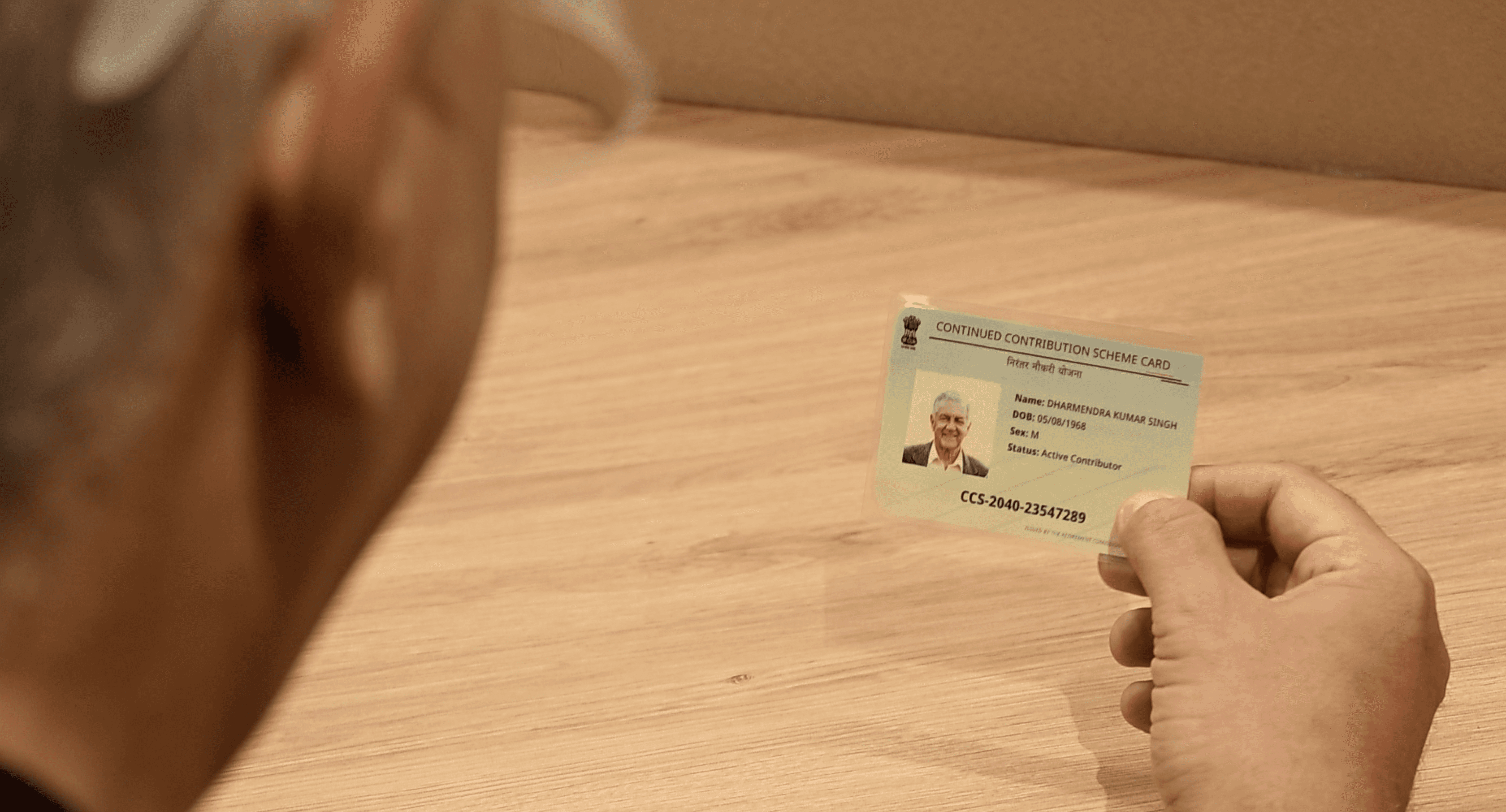
It's his choice! To demonstrate the day-in-the-life of an elderly in 2040, we created our character Mr. Dharmendra, 72 year old civil engineering is working in a private construction company through the Continued Contribution Scheme (CCS) in the post-retirement sector. He is using a custom assistive mobility exosuit (that his company gifted him) for efficient movement when dealing with physically intensive site visits. He also recently got an aMCC brainchip surgically implanted which helps him maintain his memory, neuroplasticity and attention, so that he can learn and keep up with new developments in his field. He is part of several communities for recreation, including the tennis community.
We created an immersive AR and physical speculative experience to simulate Dharmendra's Office Desk from 2040. Different artefacts were displayed in a museum-like exhibit that had interactive elements.
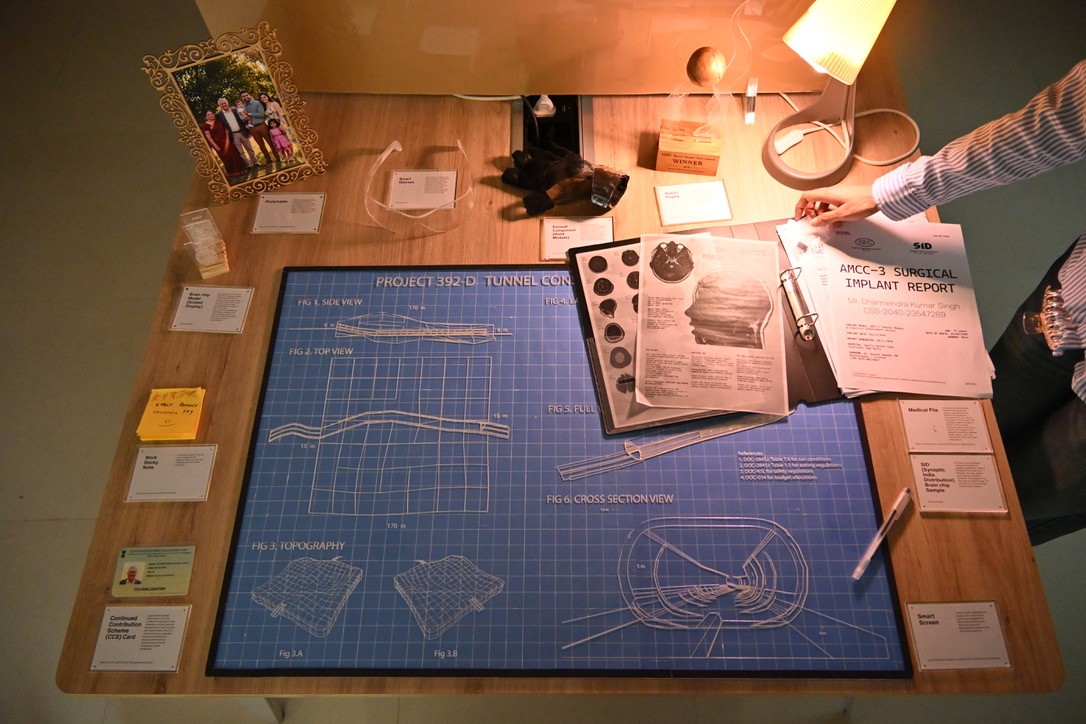
Dharmendra's desk itself would be a large interactive screen where he would study the blueprint of the upcoming major tunnel project of the state.
Office Desk of 2040 (Dharmendra's)
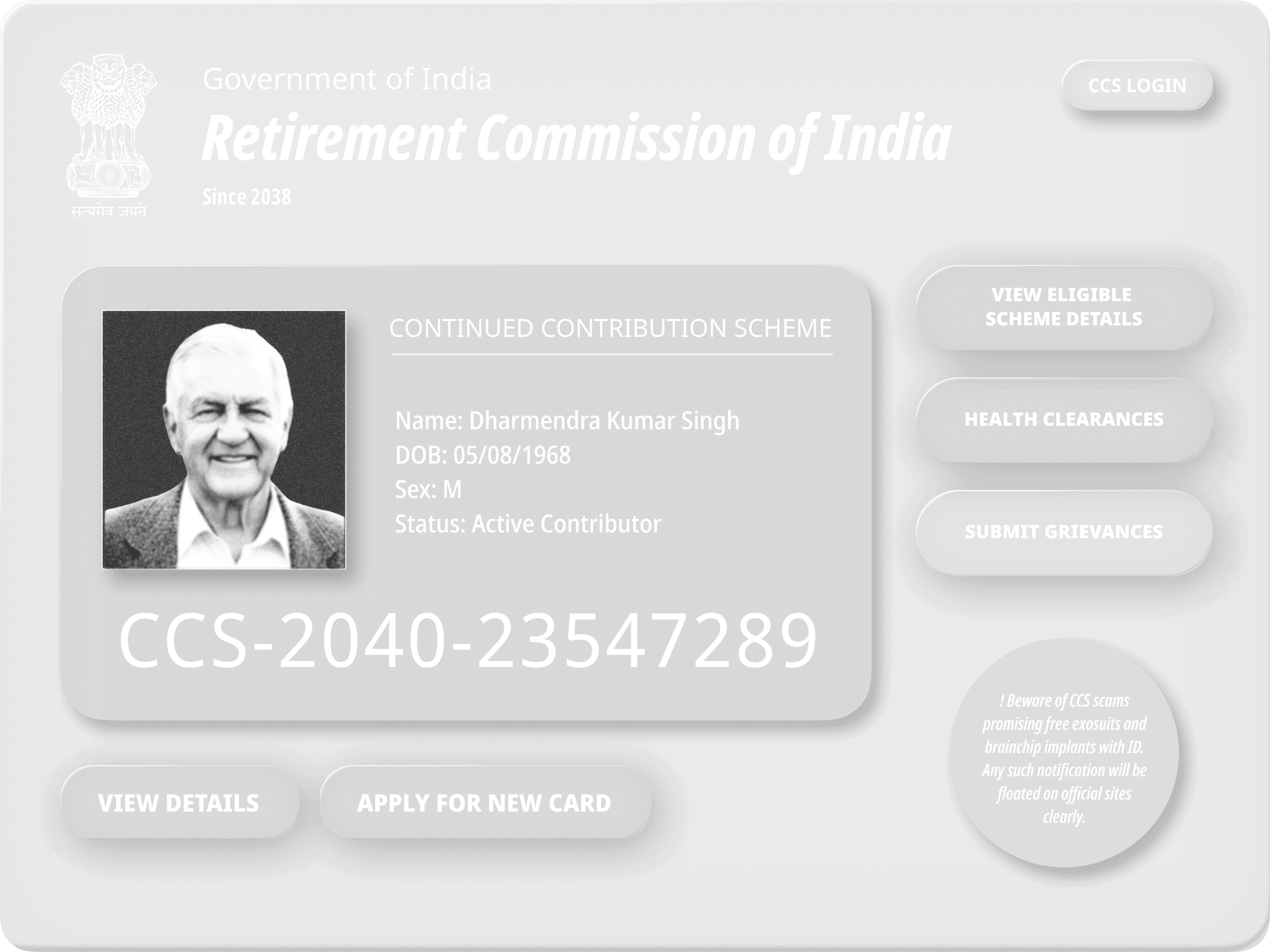
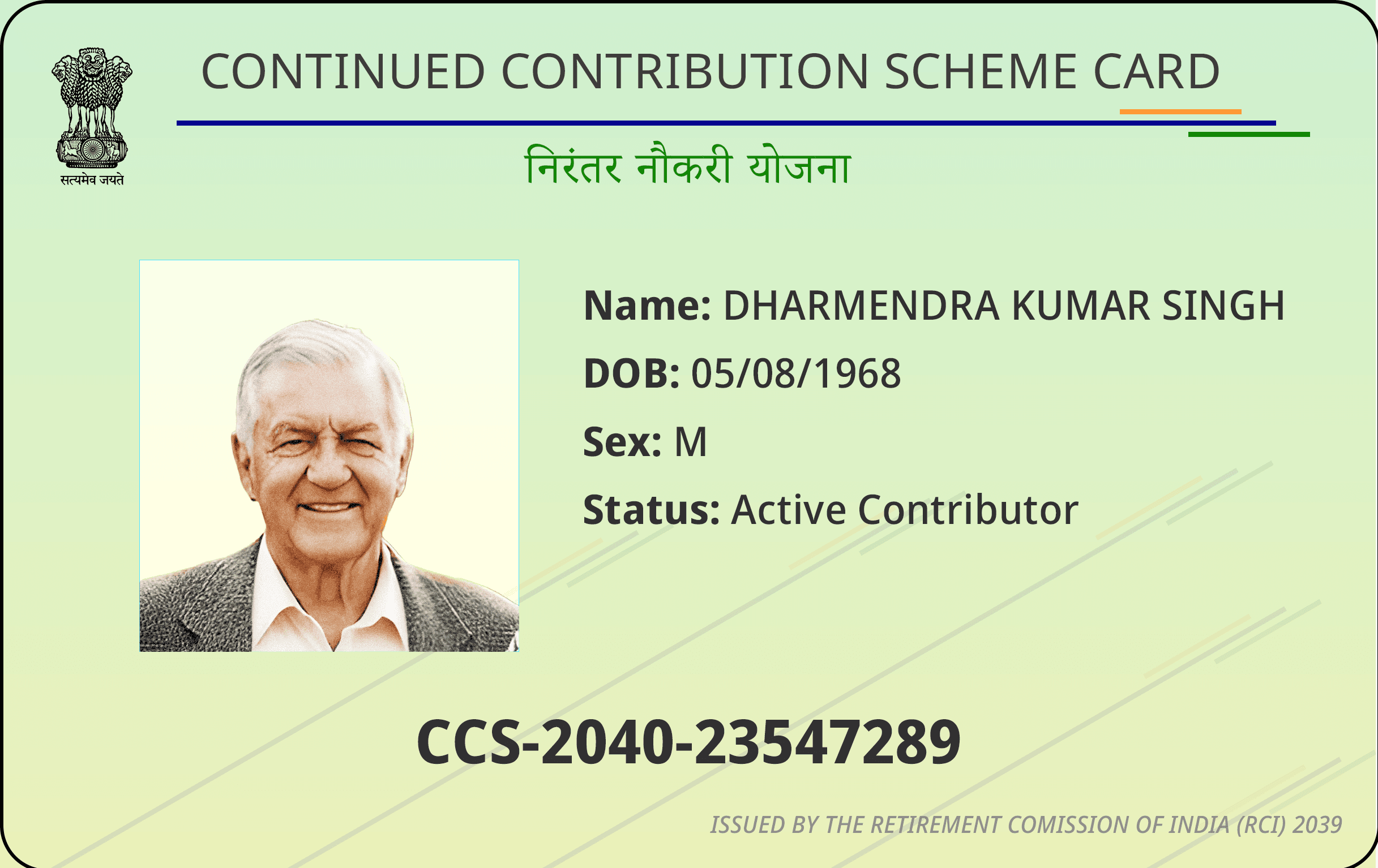
Because of Dharmendra's invaluable contribution for 30 consecutive years, his company gifts him an exosuit and offers him a post-retirement position (under the Continued Contribution Scheme of 2036). The exosuit enables him to work at the best of his physical capabilities and even play his favourite sport-tennis (he has also won multiple tennis championships and been awarded the employee of the month way too many times).
CCS card (government issued) and portal
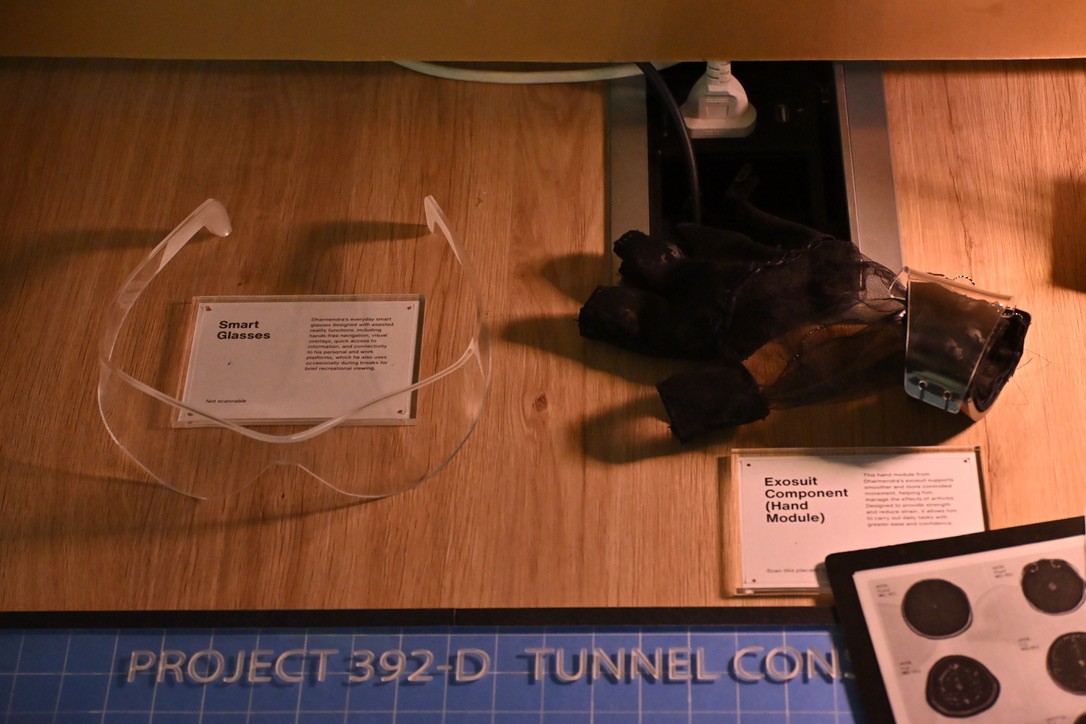
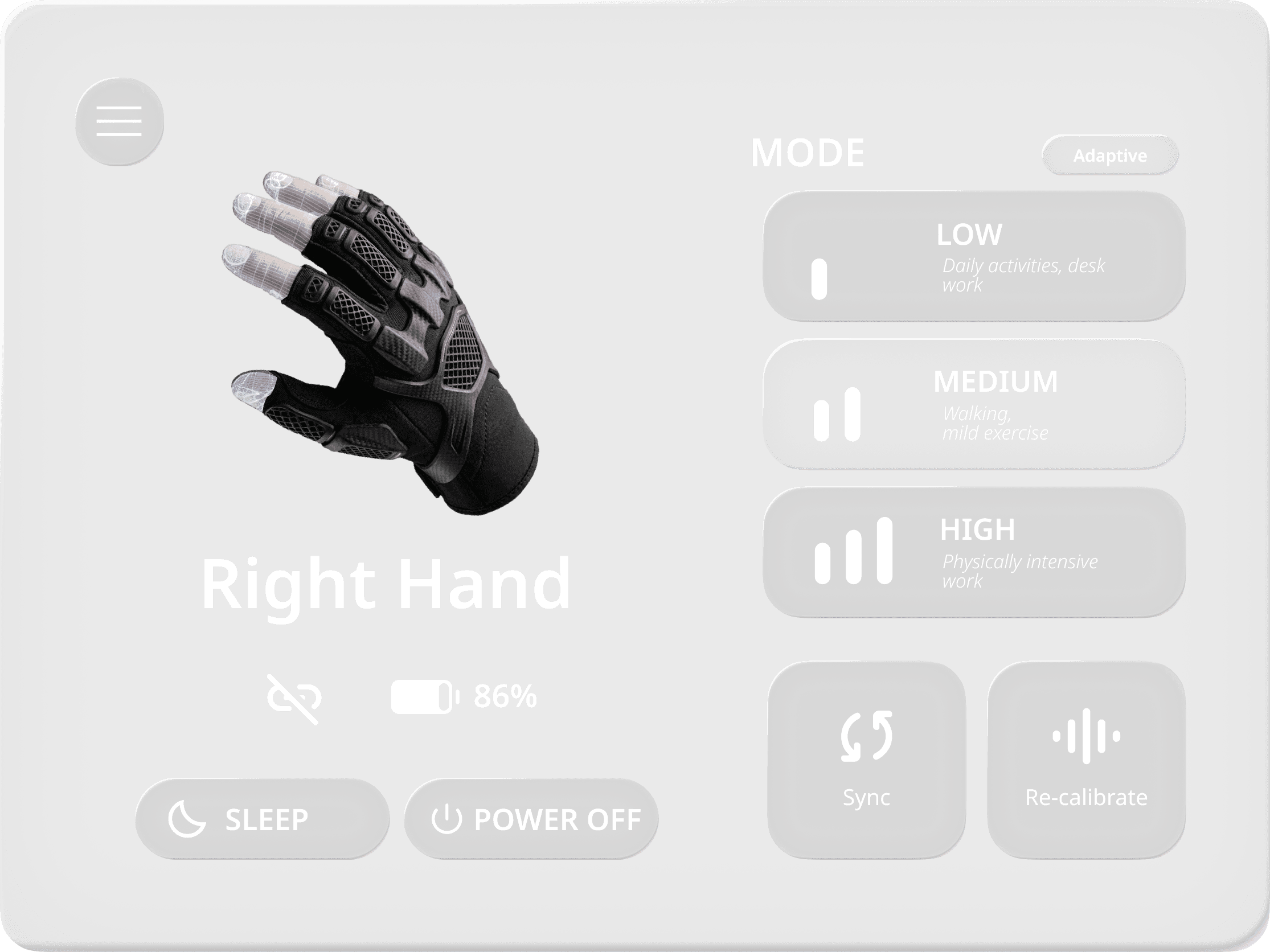
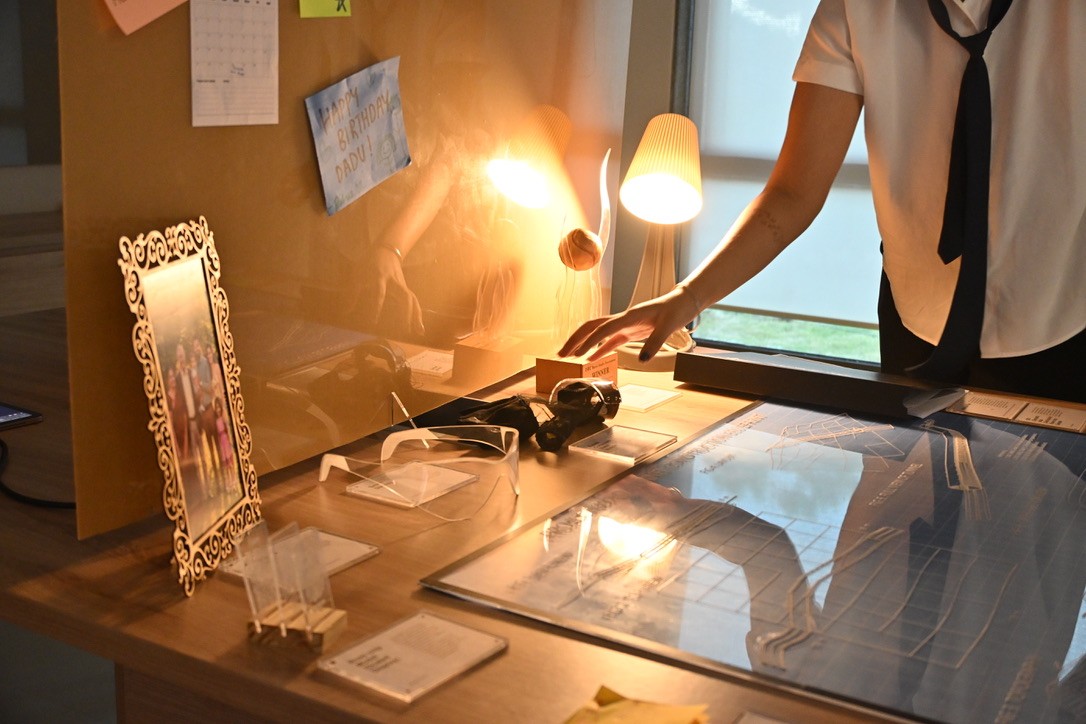
Smart glasses and Exosuit hand
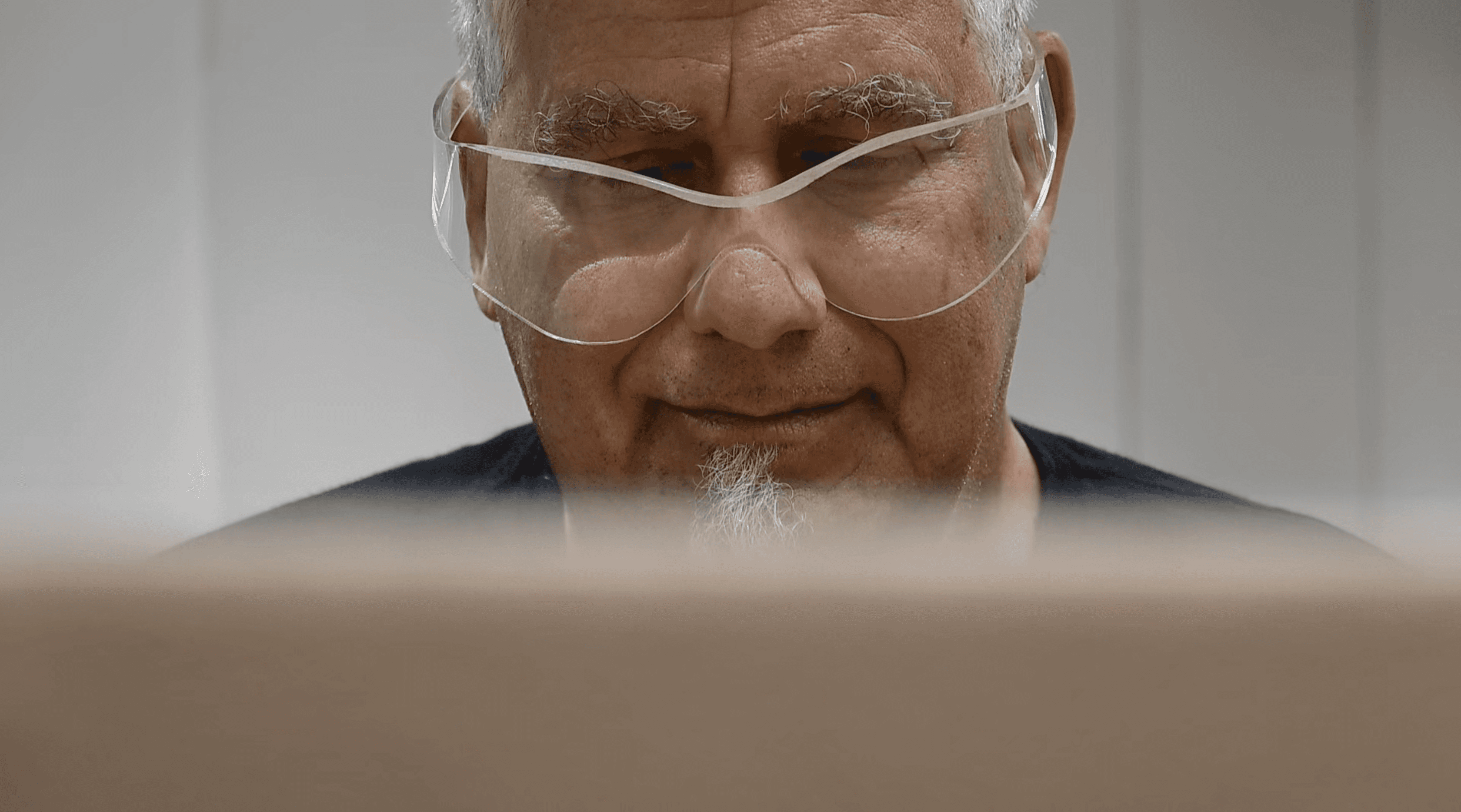
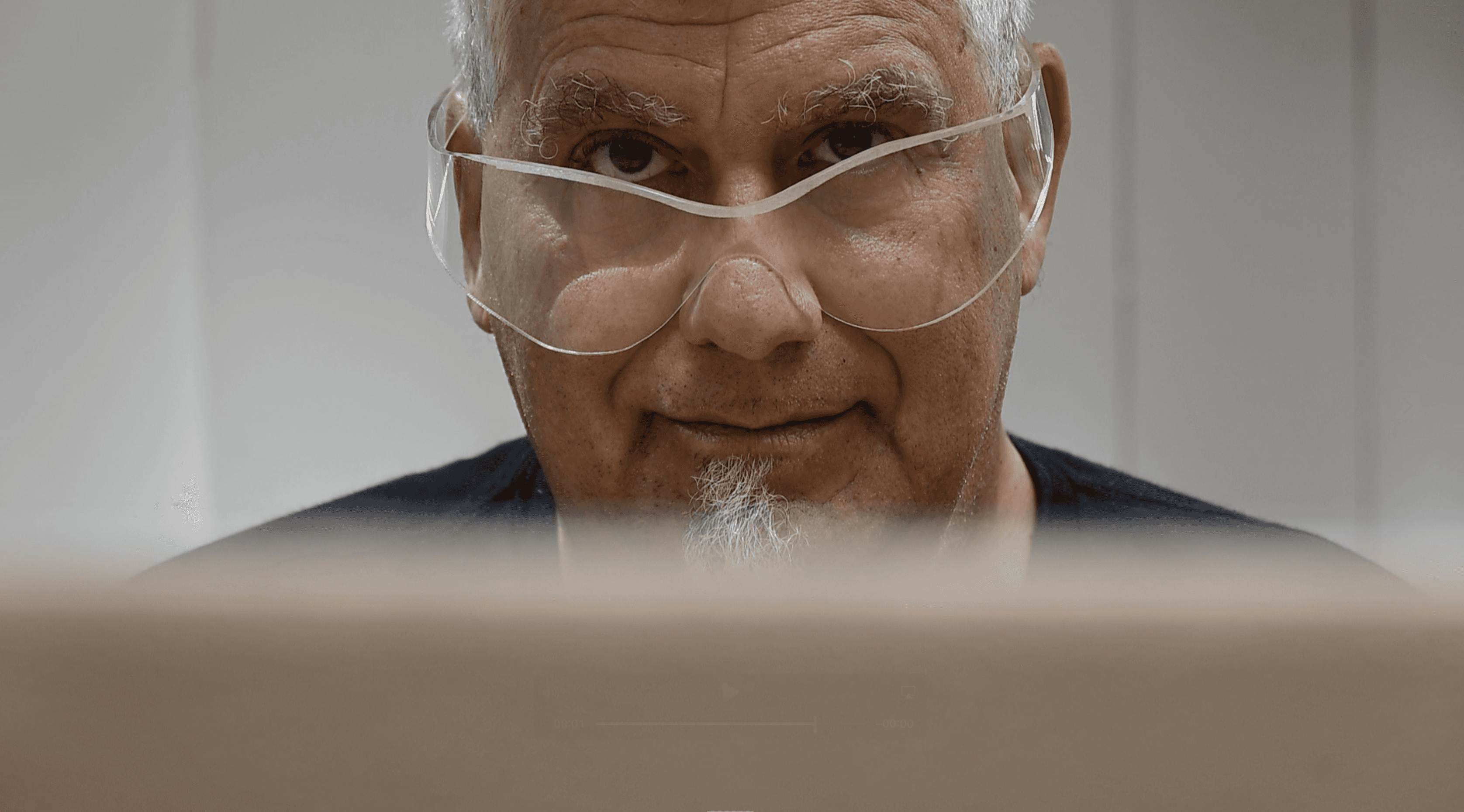
Whether he's on work mode or vacation mode, Dharmendra never takes off his smart glasses (that doesn't stop him from reciting horror stories of screen obsession 'back in his days' to his granddaughter Pihu. He currently wears only the hand module of his exosuit since he is applying for the newest version.
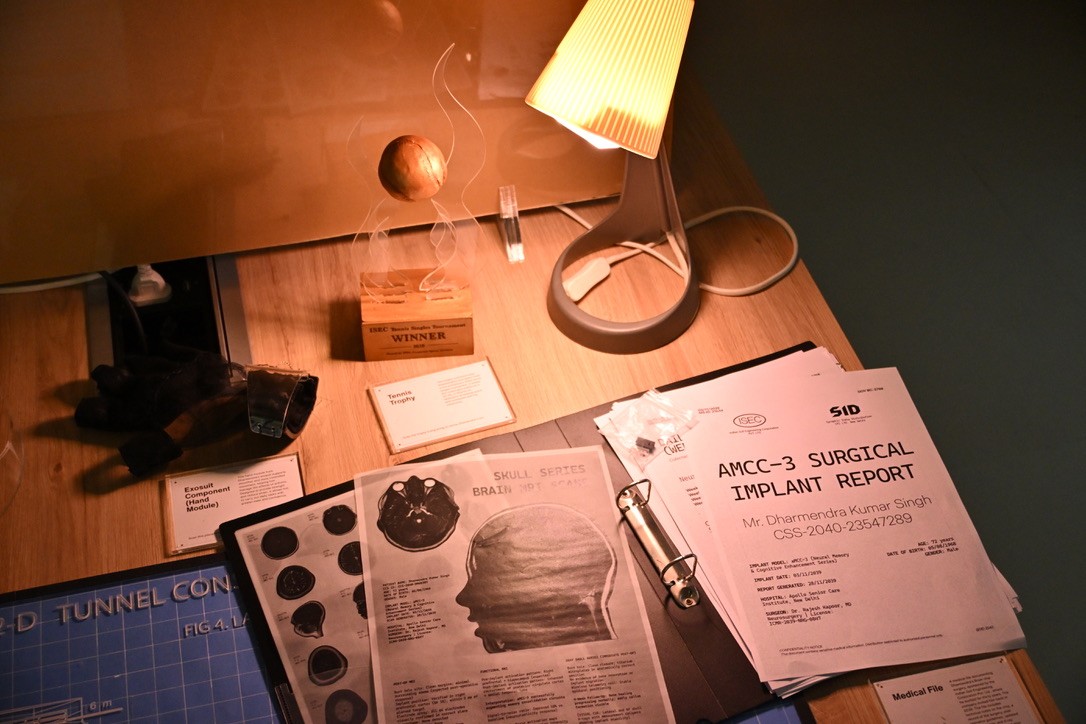
Surgical Implant Report
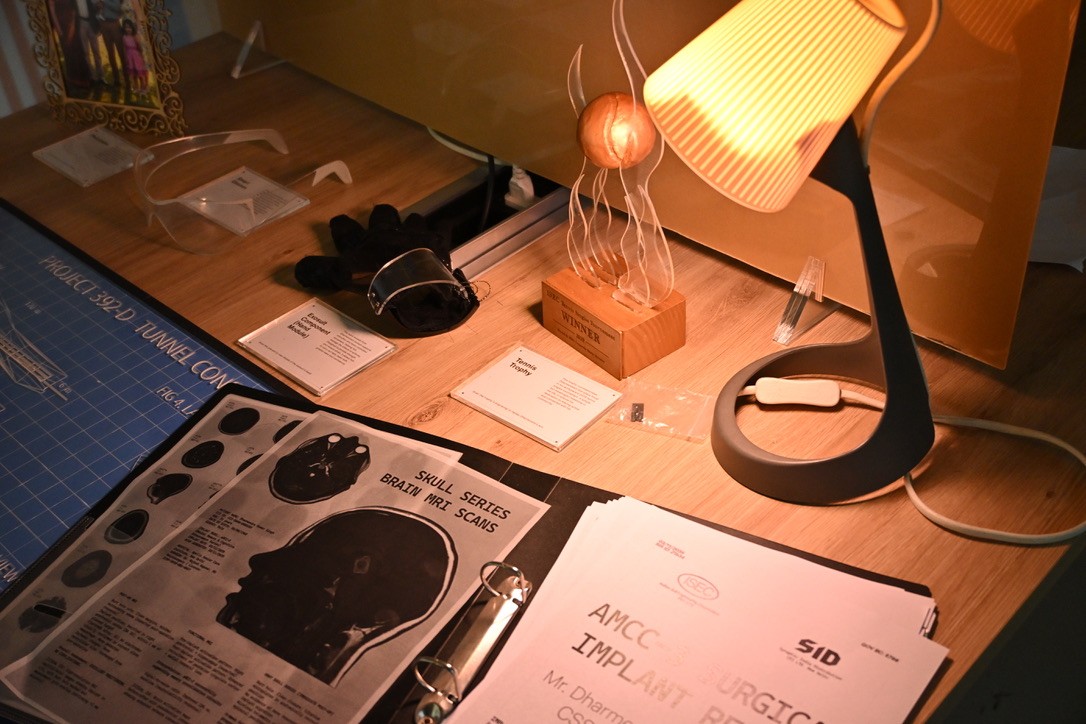
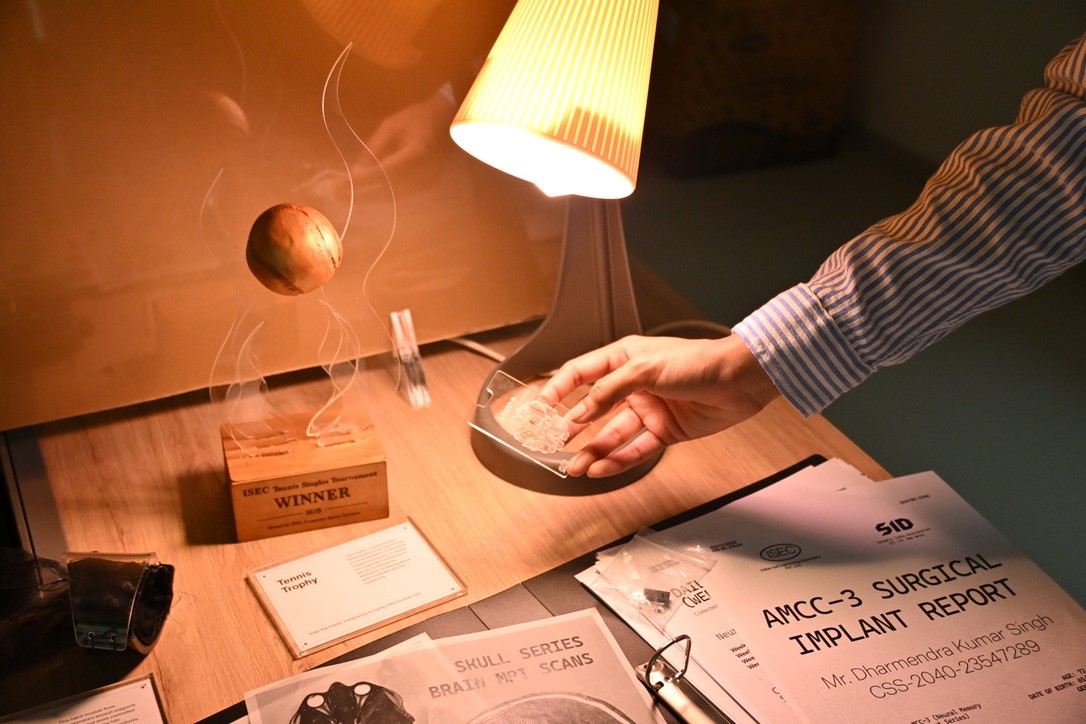
Sample AMCC-3 Chip
His company's CSR, in collaboration with Synaptic India Division (SID), allows post-retirement without any hiccups through complementary neural chip implant surgery. SID sends Dharmendra some sample AMCC chips before the surgery.
SID issues his MRI scans and complete surgical report. Within 2 days he was discharged but he still has a lot of medicines that he needs to continue for a month for a full and speedy recovery.
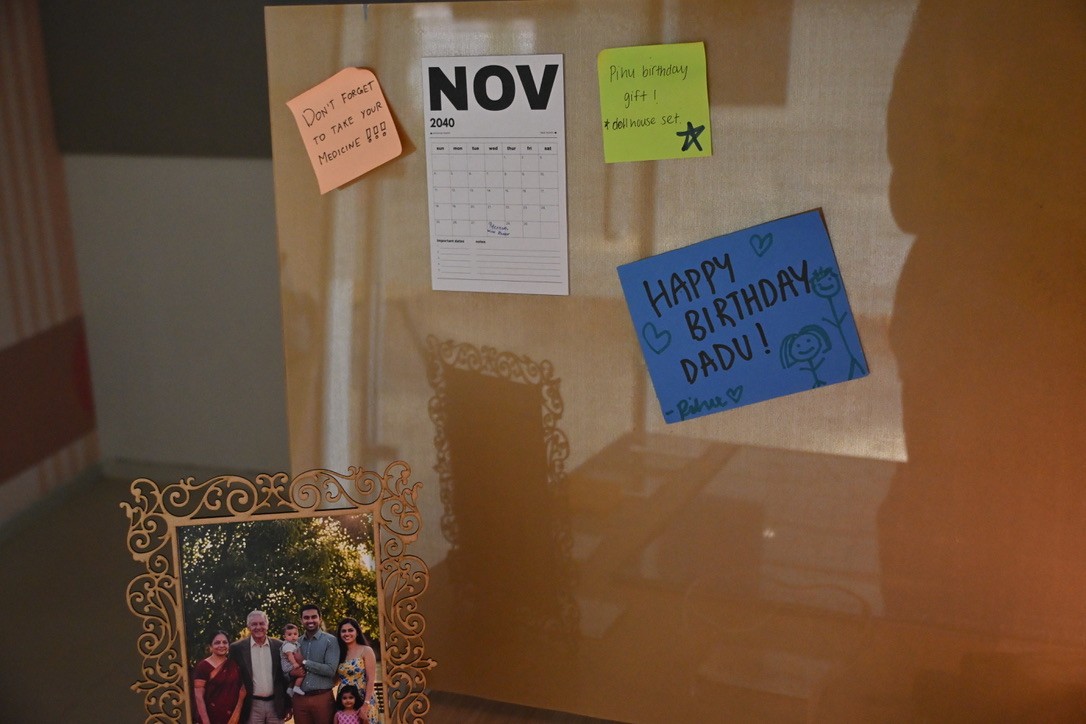
He keeps a photo frame of his family on his desk and treasures the heartfelt notes that Pihu sends him sometimes. He misses bonding over old Bollywood songs with her and is thinking of buying a pair of the latest smart glasses for her birthday present.
Family photo frame
What felt like a month-long English literature and law crash course actually reinforced my love for well-informed research and strongly enforced but loosely held frameworks that always stay open for flexibility and discourse. Working with the law students was very refreshing in terms of exchange of ideas. As someone who used to find diverging ideation and unbound imagination daunting, the project challenged me in the best ways to stay interested in all steps of the process – from framing the most suitable sentences to discussing the most preposterous of futures with the most eccentric of teammates.
Next Project