Sirf Rail Nhi: (not just a rail)
Abstract [TL;DR]
The aim of the project was to explore the motivations and thoughts behind behaviour like ticketless travel, getting on wrong coaches, etc. The team approached the same with empathy, looking at the factors driving such behaviour and proposing where a suitable intervention could be positioned. Through the process, the team conducted primary interviews, secondary research, and insight generation through the data obtained. A participatory research tool was developed to facilitate conversations about otherwise sensitive topics.
A campaign was designed to encourage a communal change in mindset regarding such behaviour and to celebrate the multifaceted nature of rail travel, with everyone and their different purposes and stories: all of us who keep the rail going.
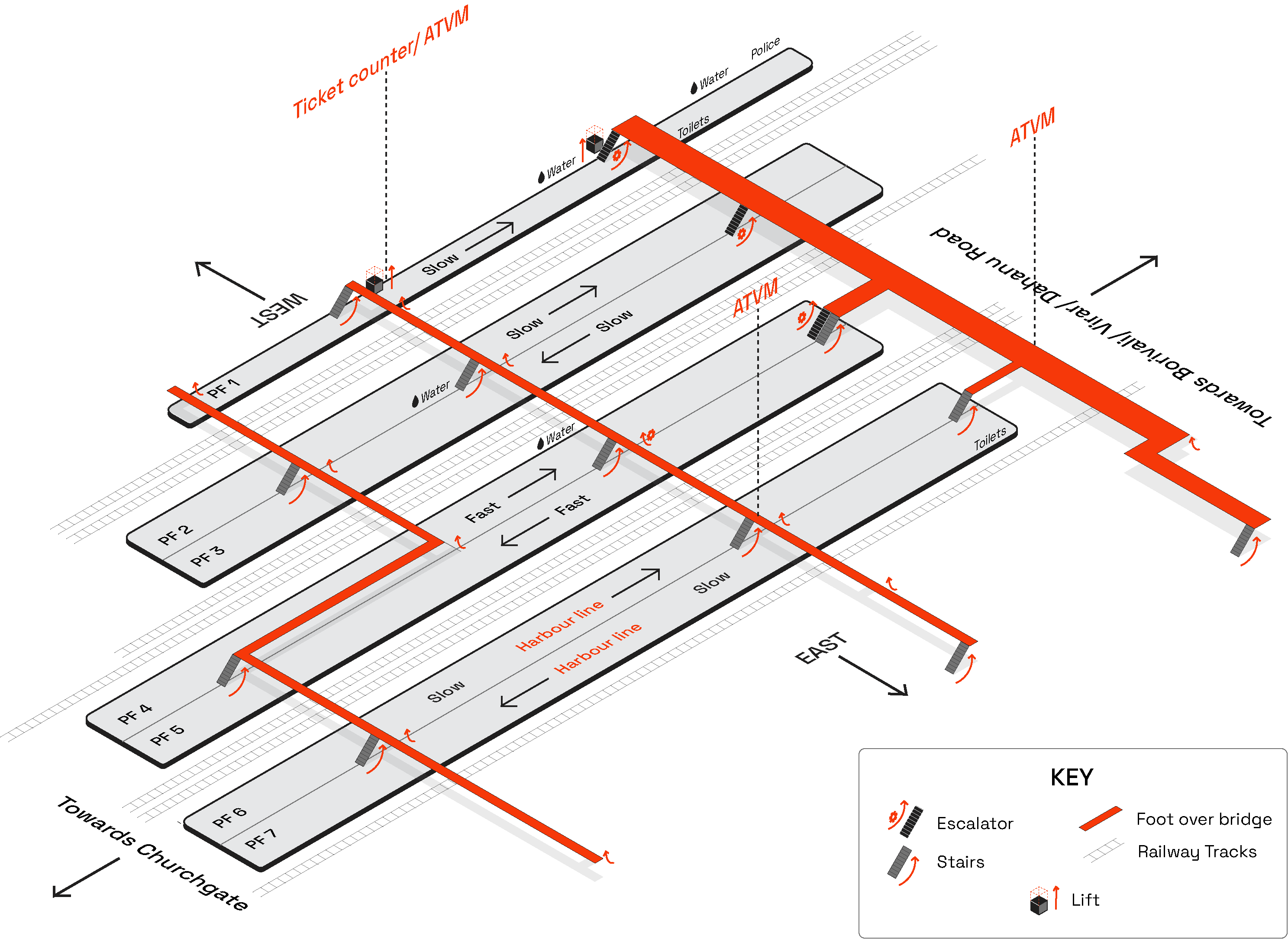
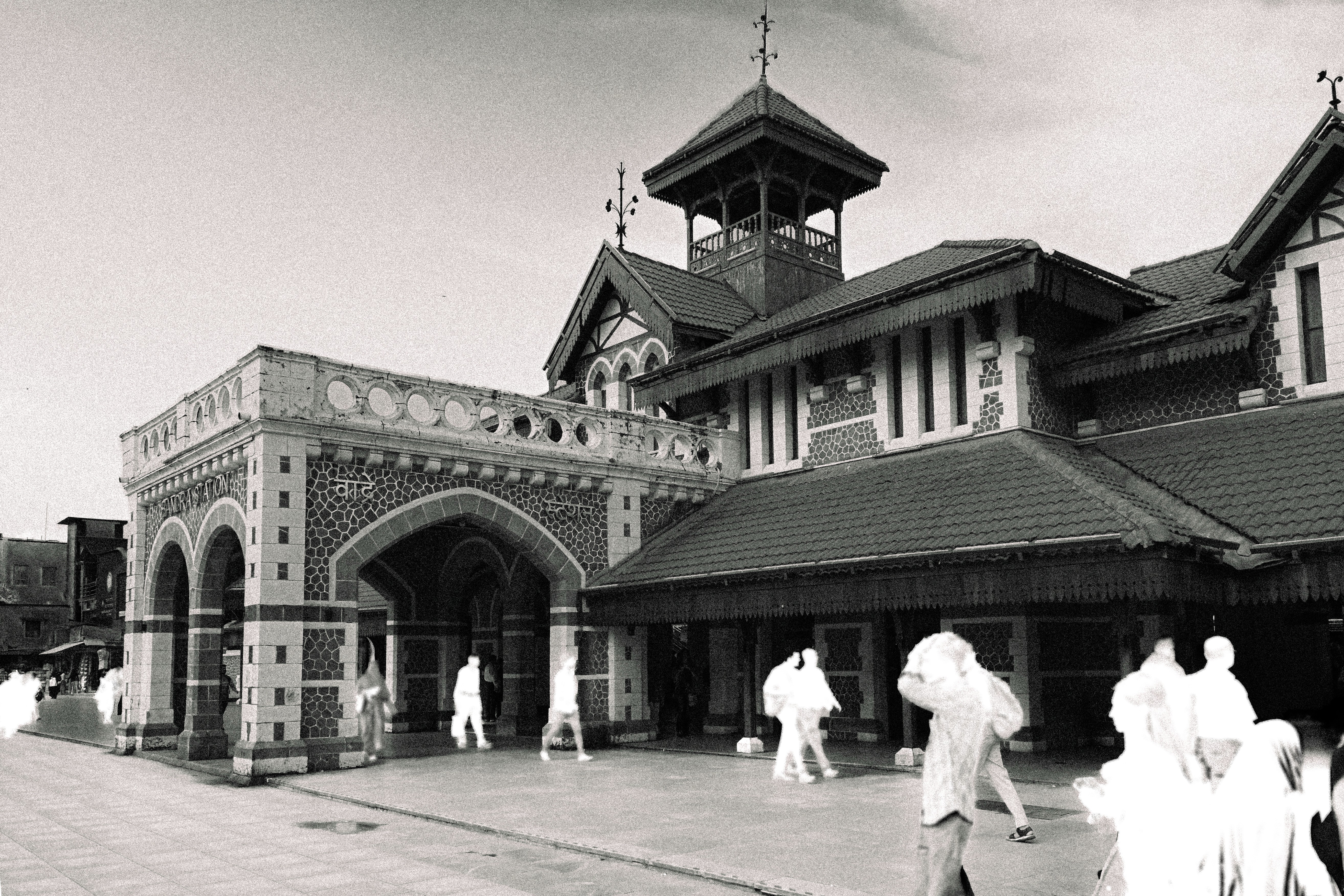
Known primarily as a Mumbai's 'Queen of Suburbs', Bandra sits as the largest city in Konkan division of Maharashtra. Mumbai majorly runs on its extensive lifelines, colloquially known as "locals" or "local trains", which are a network of inner suburban railway lines as well as commuter rail services that connect the Mumbai Metropolitan Region to the outlying suburbs. The site we worked with was Bandra Junction (also known as Bandra railway station). The network consists of three divisions, out of which Bandra falls on the Western Line.
)
Jumping onto the Bandra Bandwagon
Bandra also presents a unique condition as it is a heritage site (classified as Grade I by the Maharashtra Government)* remove, and the main building can have no new developments done that alter the infrastructure of the main station building.
There are 3 locations to buy tickets, and both ATVMs (Automatic Ticket Vending Machines) and ticket counters are available. Tickets may also be booked through the UTS Mobile app although it is not possible within 20m of the station and track to prevent misuse.
)
"Areyy photo nikaal!" (heyy take a photo!)
Exclaimed a very enthusiastic Chaitrali when we saw some people crossing the tracks (prohibited by the railways) on our first field visit to the station. The combined curiosity of the team led us to define our research objective in this landscape of deviance from a system designed specifically for the public.
)
Research Objective
To investigate system deviants' motivations and perceptions that lead people to engage in rogue behaviour*, and devise frameworks and prototypes to prevent this, by reinforcing mutual dignity within the systems (information and policy) of Bandra local station.
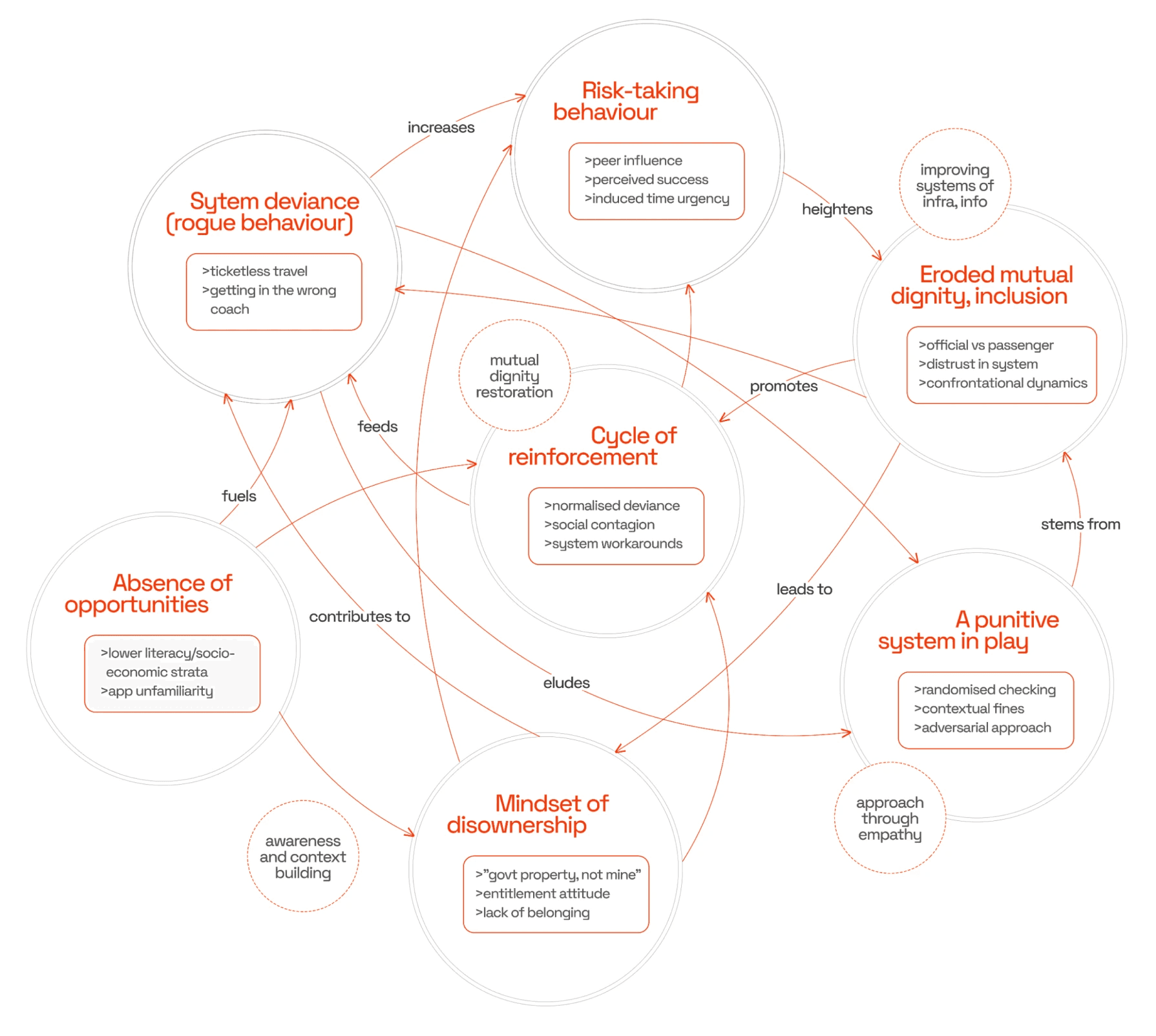
While mapping the multi-stakeholder ecosystem of the railways, we had clarity on keeping our primary focus on passengers, ticket collectors and railway officials. We created a systems chart to (fig) visually analyse the complex interdependencies and feedback loops underlying the rogue behaviour. We represented the abstract social, psychological, infrastructural, and enforcement factors as nodes and mapped their real-world causal relationships to understand where breakdowns occur and why they persist or reinforce each other.
)
Despite multiple levying of heavy fines for particular coaches (second-class, first-class and AC), ticketless travel in the unreserved lines remains high (?). This further contributes to overcrowding and safety concerns in one of the busiest suburban railway networks in the world. The government has installed cameras, formed human TC (ticket-collector) chains, and has run numerous campaigns, but the impact of efforts stays stagnant in terms of addressal of the wider wicked problem. (?)
)
Playing with trains
Like any other budding designers, we were attached to our initial aha-moment of a campaign idea: "Kya hi hoga?” ("what will happen?" – rhetorical and dismissive: an instinctive feeling people get about acting on rogue behaviour). This sort of negligence towards the consequences of acting on such behaviour required deeper probing.
We couldn't just ask people, "Didi (sister) do you travel without tickets?" or "Bhaiyya (brother) do you get into the female coaches often?" (do not try; you would immediately get thrown off the coach/stared at/get cursed at in Marathi).
Based on our previous beloved experiences with creating participatory action tools in year 1*, it clicked to Simona and me together that it's time to play, and we created Rail Chase.
)

>
[simulation of crowd movement]
[to show usage of UTS/m-indicator]

[time reduction as a fine: controlled by game master]
[real life-like, high frequency support available]
[induced urgency for quick decision making]

>

>
>

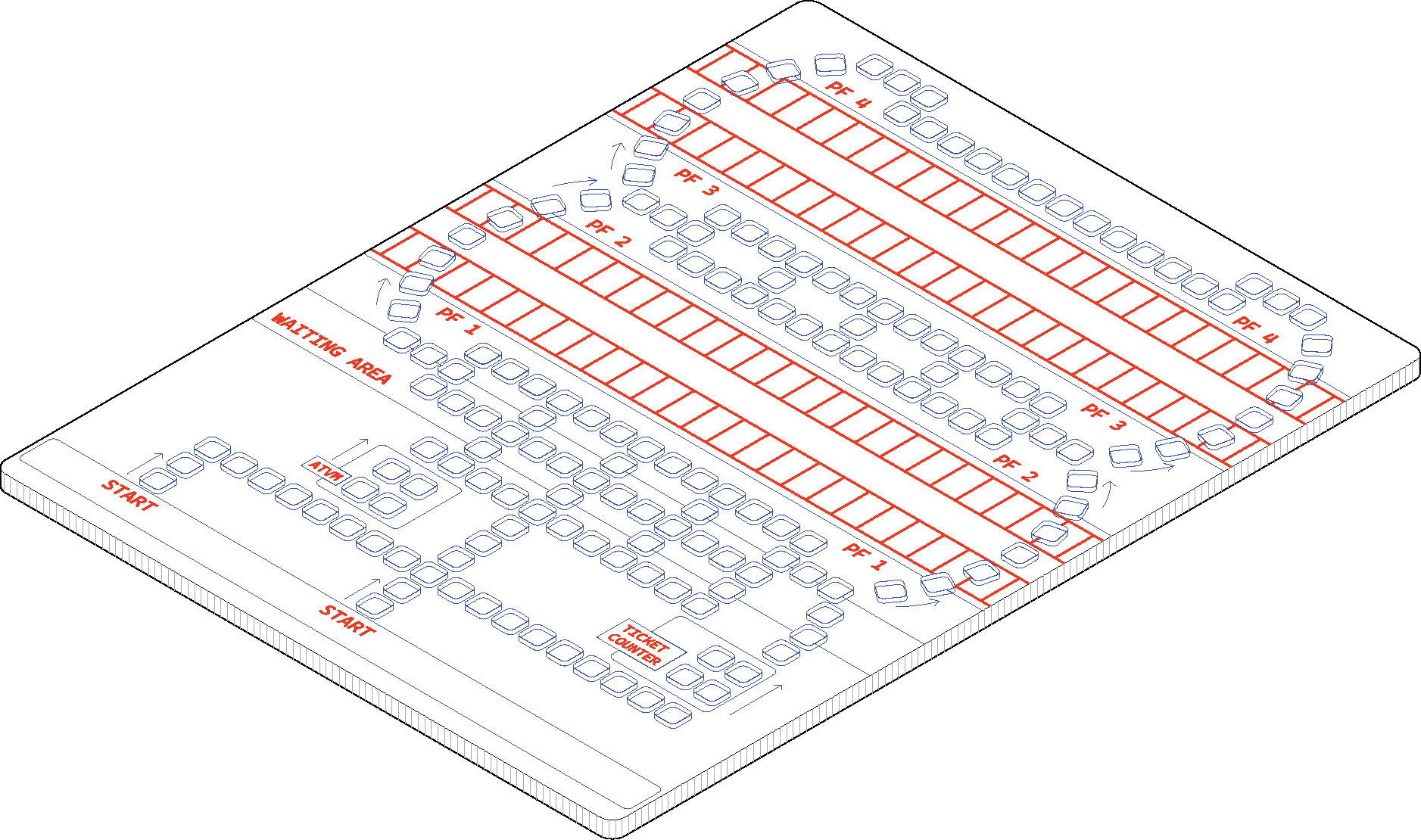
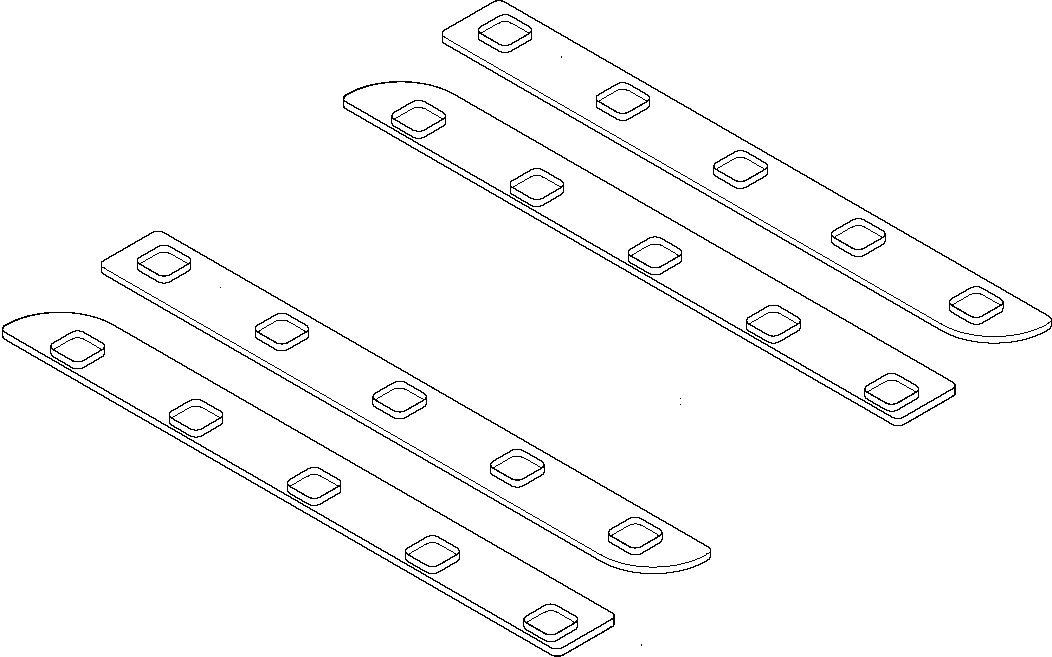
Rail Chase is a simulation board game where players navigate a simplified version of Bandra Station to catch a train in time, which recreates real-world constraints like time pressure, ticketing, and boarding correct carriages.
Through the game we had to induce the same sense of urgency, frustation, time and monetary constraints, crowding etc and all of this had to be simulated in a way that it could be played in a air conditioned room and still offer insights. At first we tried to rig some scenarios where a randomised algorithm would always work against them and thus make them frustrated initially. But as we played along, some players could beat that seemingly impossible level easily and it gave us one of our most valuable insights about familiarity with the system. For someone who has enough lived experiences, the constraints become background noise. This helped us regain our trust in keeping the game closer to reality.



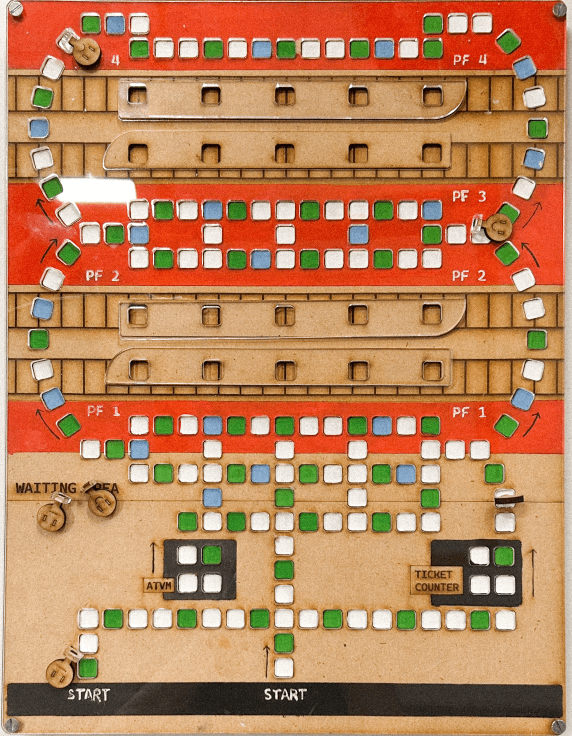
Board
Dice
Player pieces
Chance Tiles
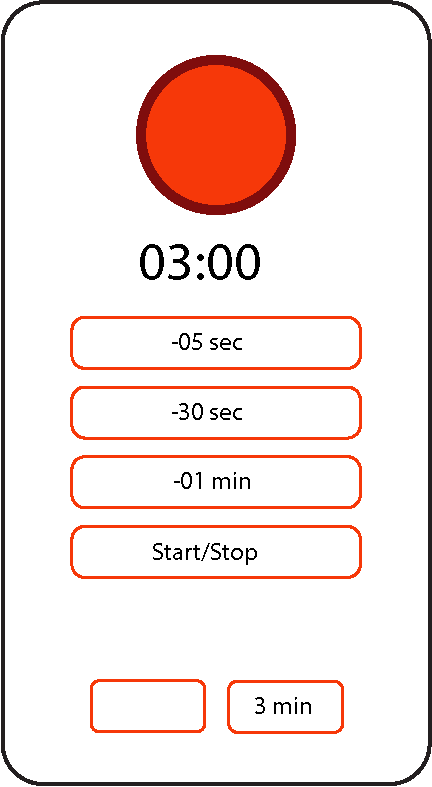
UI for Ticket Collector
gives a 20% chance of ticket collector encounters on each dice roll.
Time change depending on level
with a ticket
Meeting a TC
without a ticket
Boarding an AC train without ticket
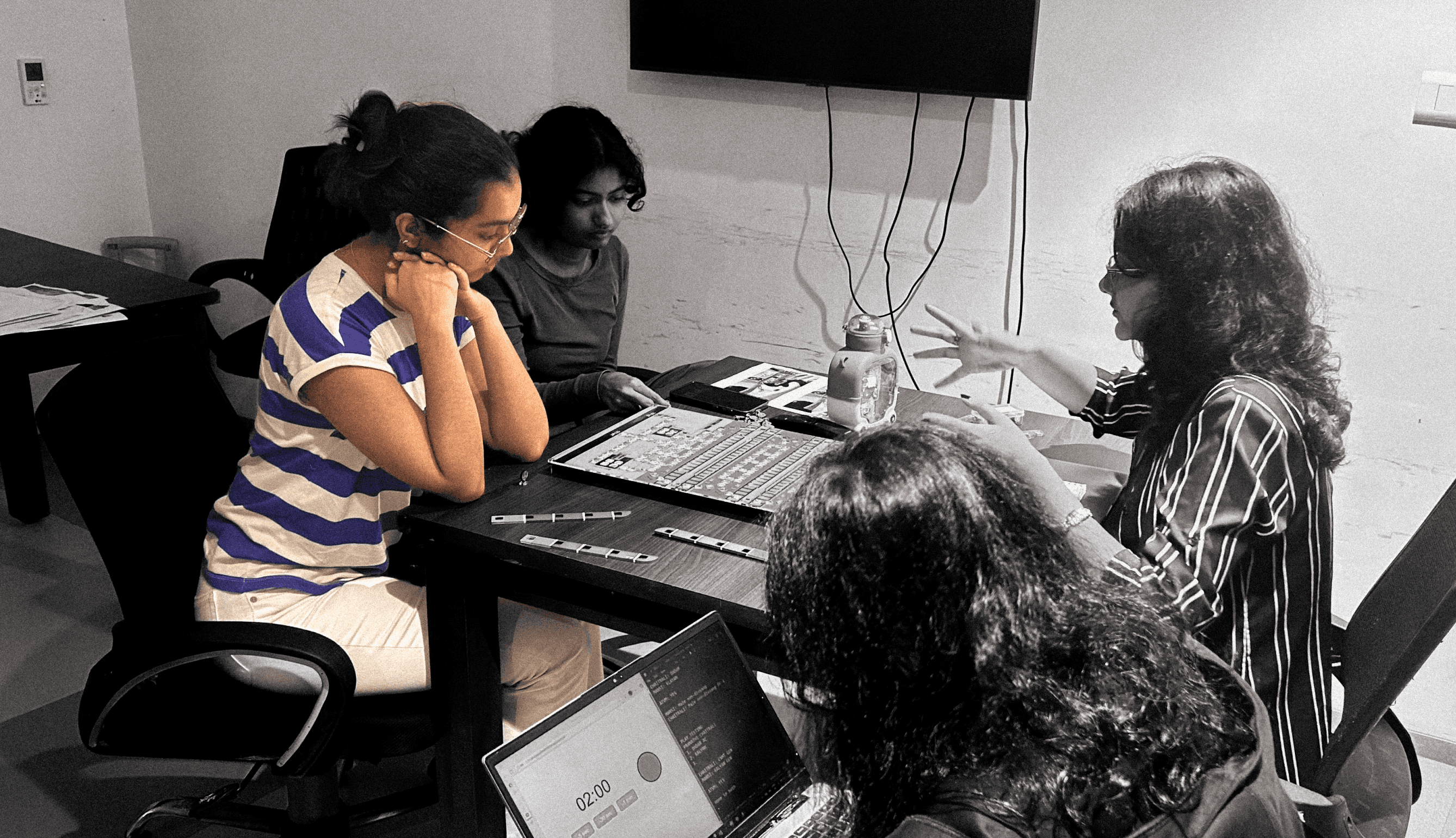
“This feels impossible with the time constraint”
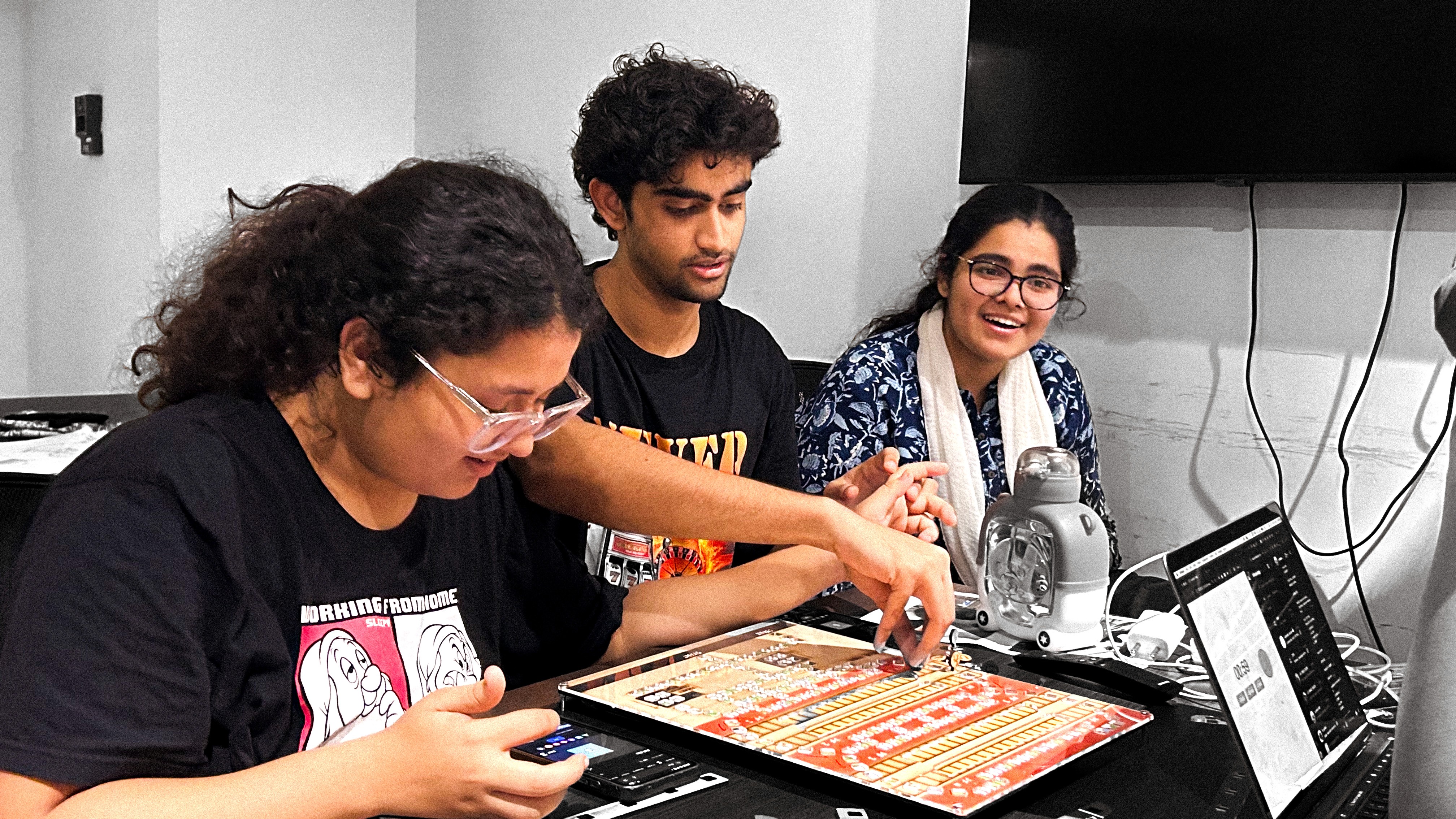
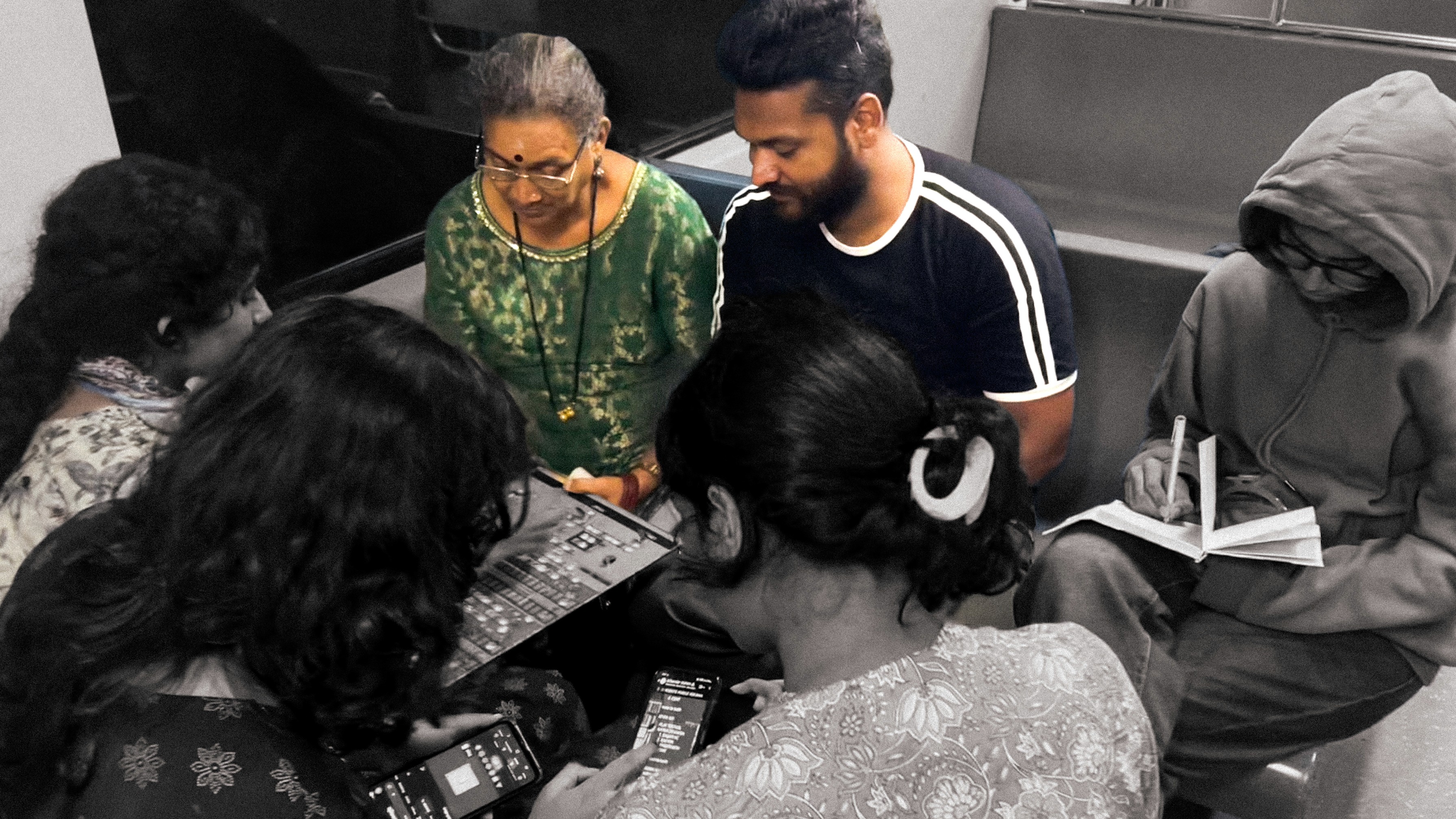
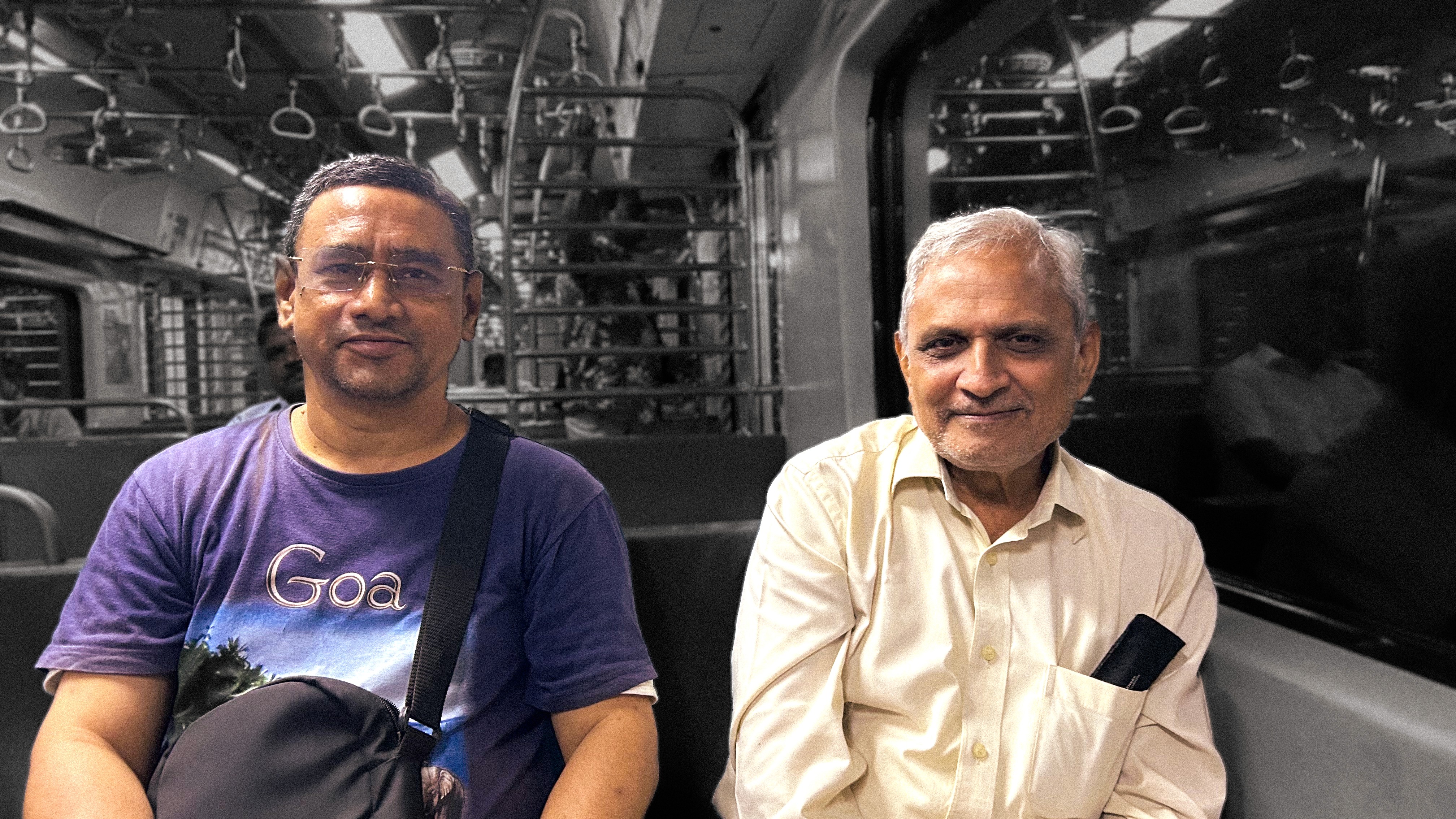
30+
games played
from ages 12-81
“I won without even getting a ticket”
“I dont have enough time to buy a ticket and figure out my platform, I’ll miss the train”
design students
academic fellows
faculty
passengers on the train
people on the platform
railway officials
“People keep their houses clean but treat the world outside as a dump without even getting a ticket”
We created multiple mechanisms like a dice roll to simulate less or high crowding, increasing complexity through multiple rounds (to judge familiarity); chance tiles for help and announcements; and heavy dilemma-inducing ticketing choices like:
>take from the ticket counter (longer route, very slow)
>take from ATVM (super fast, works only half the time sorry)
>run without a ticket
Also a fancy, random, rigged TC algorithm that we ran randomly that would deduct their precious minutes of boarding the train.

Beta I consider the humiliation to be a part of my job now.
-Female TC at Bandra Local
“
During one of our interviews with a lady ticket collector, we enquired if she had ever encountered extreme aggressive behaviour that people might show when they are penalised. She said that just the hour before she had been slapped by a female passenger, and when the TC took her to the Railway Police Force (RPF), only then did the severity hit her, and she started begging on her knees to be forgiven. And this keeps happening multiple times. When we asked her why she thought this happened, she just said,
Our team collectively had goosebumps hearing her diction. This story was a pivotal point for my team, where we could painfully empathise with her and realise the dire need for reinforcing the lacking mutual dignity between the community and the officials.
“
“
I was in a hurry about where to go, I forgot about taking a ticket completely.
-Old male passenger
“
-Adult female passenger
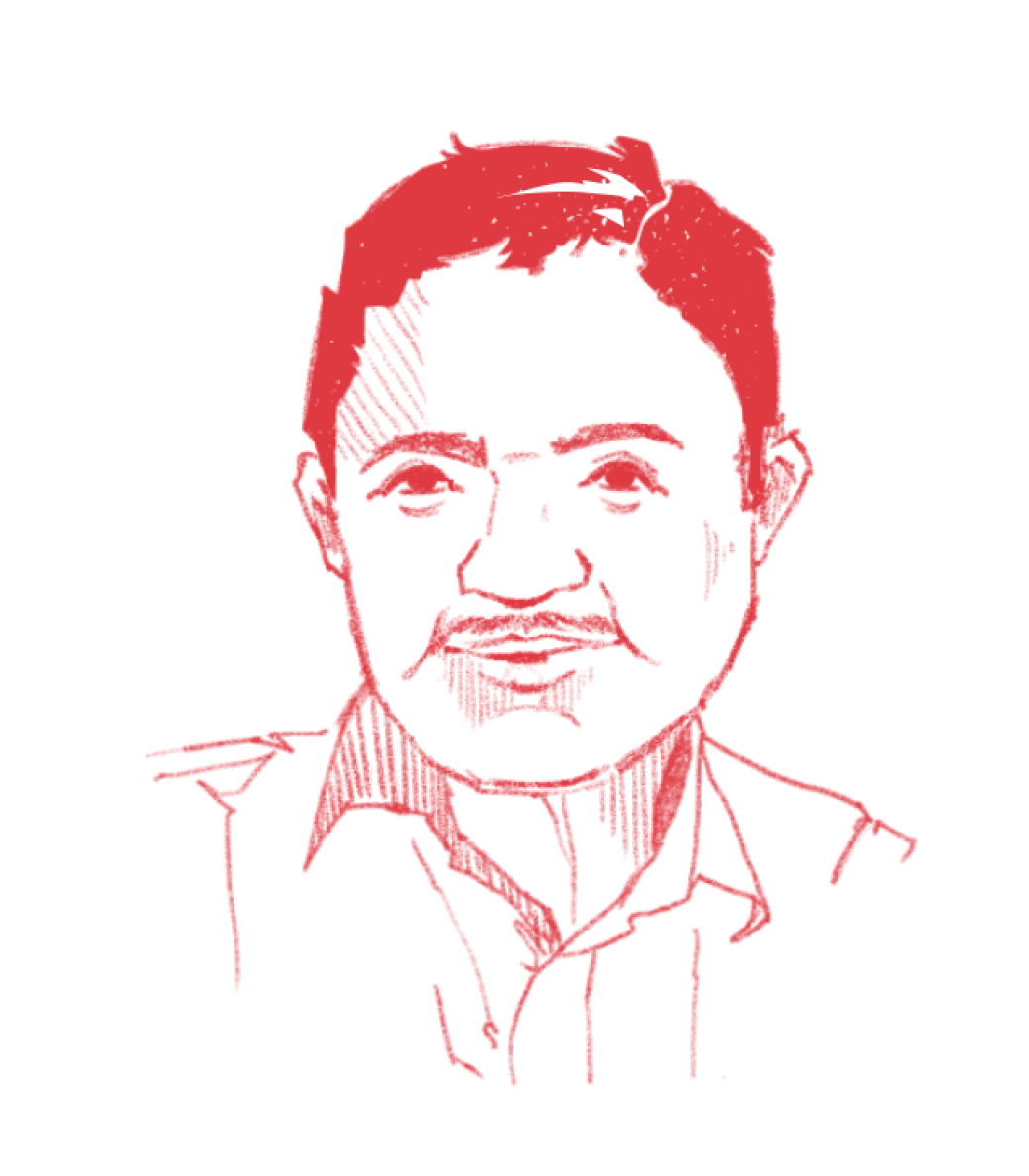
Back in my days, I used to cross tracks all the time until one day I almost lost my life because of it. Never again.
My friends and I also actively tried finding ways to fool the TCs.
Next time, I’ll get a ticket first, now that I know I have enough time!

-12yr old boy

“
People might think they’re entitled for the services, and expect it to be free of any expense.
-Divyang, researcher

After receiving multiple other heartfelt anecdotes from people, we surmised that the rail had to be aapli rail or our rail> a collective sense of belonging. We created four mail insights to direct our conceptualisation.
People’s actions are influenced by their perception of ticket collectors as representatives of a punitive system*. Bridging this emotional disconnect can reinforce mutual dignity and trust for both parties.
Punitive and surveillance measures cannot fully address people’s attempts to bypass the system*, and to bring about a fundamental change, a communal shift in mindset is required.
The induced urgency from the environment of the railway station enables people to regard risks as a worthy gamble for their time and money and for better experiences. Visibility and realisation of consequences can act as a deterrent.
People display a mindset of disownership and regard railways as a service they are entitled to. Ensuring a sense of personal belonging can evoke accountability and care for the railways.
*by “system” we mean infrastructure, information and policy systems.
INSIGHT 1
INSIGHT 3
INSIGHT 4
INSIGHT 2

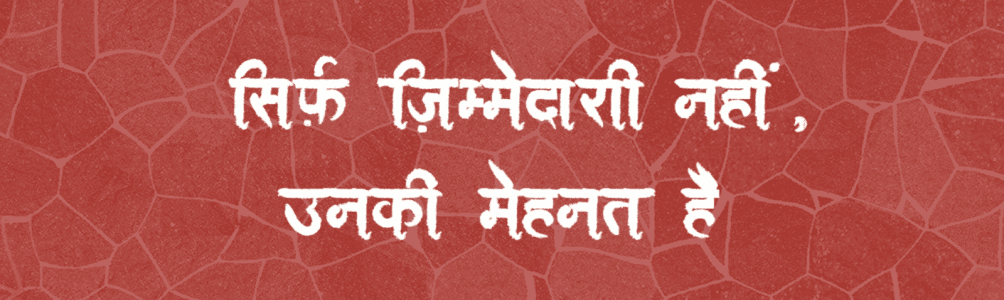
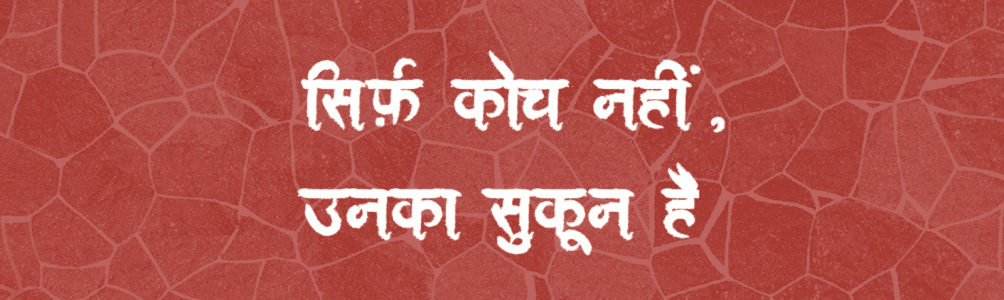
Sirf Rail Nahi, #NotJustARail is a multi-episode film series that spotlights everyday negligent behaviours on the railways: moments that don’t stem from ill intent but from a lack of dignity and responsibility towards the system as a whole.
It couldn't afford to feel like 'just another campaign by the government'.
Sirf Rail Nhi woudl unfold through weekly screenings of short films, posters, and nostalgic comic panels inspired by classic periodicals, shared across Instagram, newspapers, and online platforms to spark both recognition and reflection.
What ties every campaign medium together are the closing quotes: short, powerful lines that ties each story with our central thought #sir rail nahi. For eg:- “Sirf coach nahi, unka sukoon hai.” (Not just their coach, but also their comfort").
Our insights made it clear that the behavioural change required would be an India's problem: something we can't solve for in 3 weeks. So we chose to create our campaign "#SirlRailNhi" (#NotJustARail) specifically targeting the people who don't actively exhibit rogue behaviour out of criminal intent but rather ignorance. These people could be prompted out of it through simple reminders of identity, care and collective belonging.
no change in people’s mindsets or behaviour
some get influenced and try to empathise with the system
people perceive the campaign as a attack on themselves
domino effect: bystanders work actively for a systemic change
some view it as “just another government initiated campaign”
phenomenon
event
intervention
desired impact
our visual campaign launched in collaboration with Western Railways
increase in rogue
behaviour like
ticketless travel
Timeline
t=present
[phenomenological lens]
t=implementation
t=impact assessment
[ontological lens]
Xa
Xb
Xc
Xd
Xe

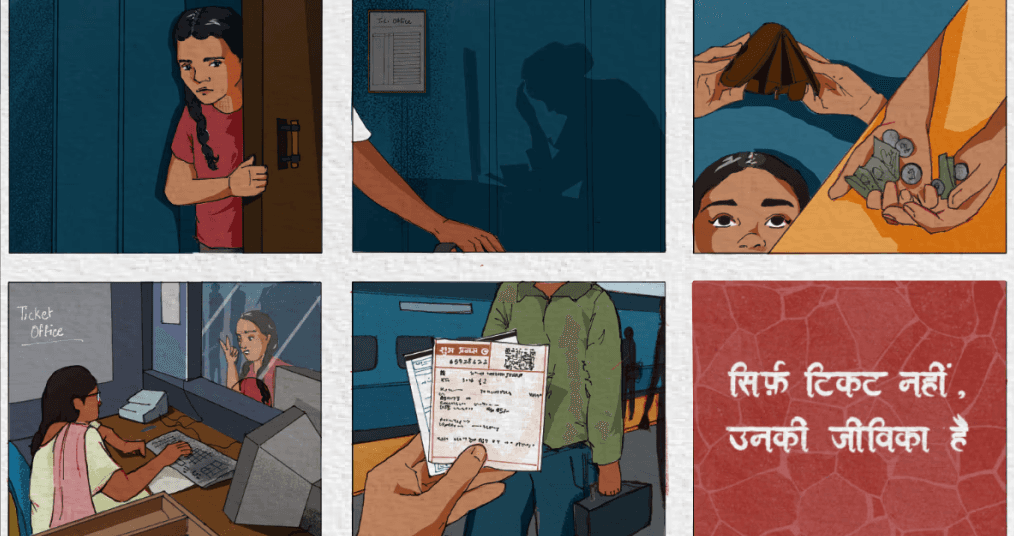
We included nostalgic comic strips, inspired by classic periodicals to introduce key themes and upcoming episodes. These would be published in the Bandra Buzz newspaper and across online platforms.
Each panel acts as a teaser “ coming up next on sirf rail nahi ” building anticipation while making complex issues easy and relatable.
fig. comic panel "not just a ticket, it's their livelihood"
Who owns the rail?
To understand how the behavioural change that we intended to bring with the campaign would pan out with time, we constructed a framework of transformation to assess the campaign's impact. We introduced the event as a phenomenon and hypothesised the negative, neutral or positive domino effects that could be observed on the basis of ontological and anecdotal evidences that we could collect.
With over 8 million daily commuters of local trains, visual narratives designed to operate on such scales need to carry care for the complexity. Multiple campaigns have come up in the past, and no one has batted an eye. If given the wrong, preach-y idea, people’s perception towards the railways being an authoritarian system bereft of humanity could worsen. For a domino-like effect to happen, people need to feel they have a stake and a voice in the very system they wish to bring a change in.
It is not fun trying to film a video in an empty (they are never empty) local coach with your team (no one knows what they're doing) and falling from said coach and almost dying (for the love of the game). Good thing design research is fun.
Next Project