We are so back
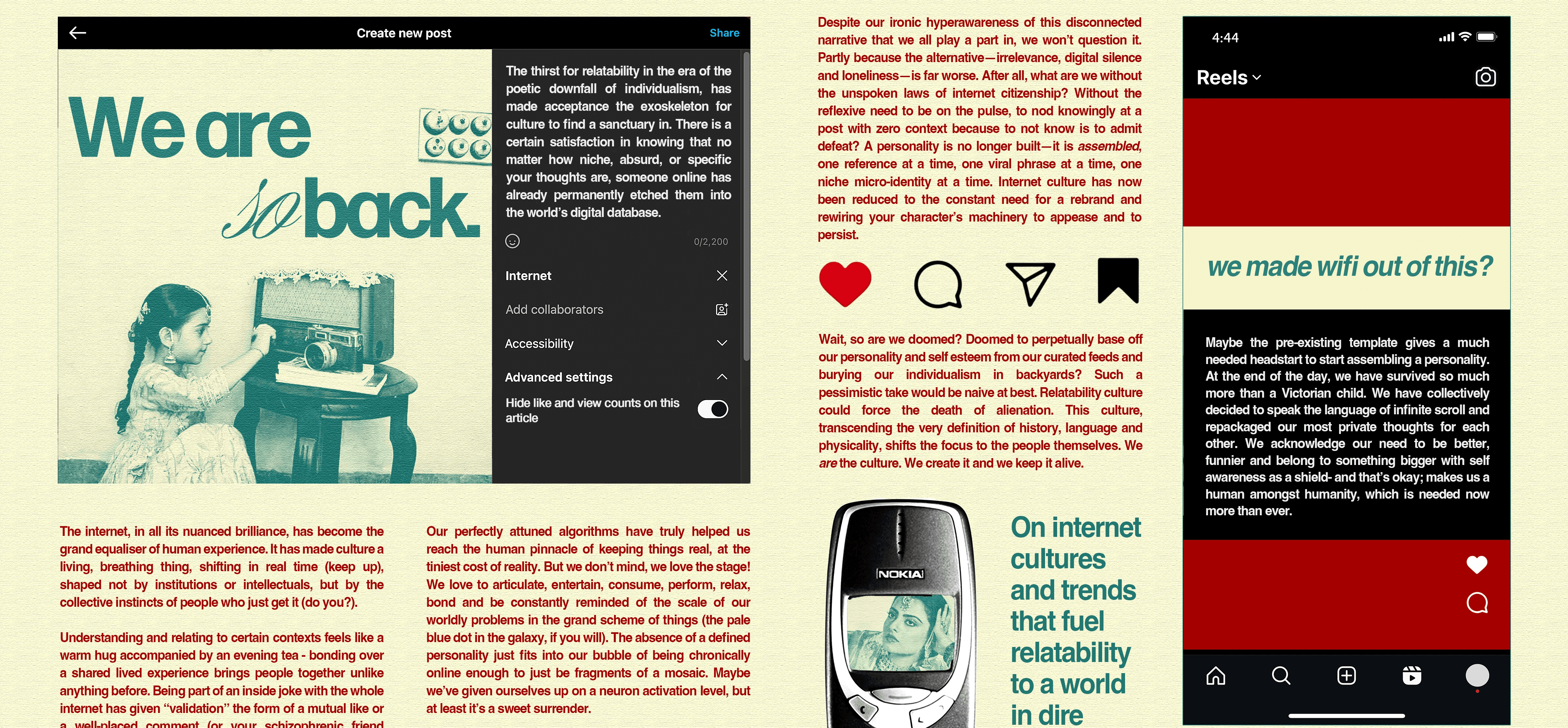
In the era of the poetic downfall of individualism in the thirst for relatability, acceptance has become the exoskeleton for culture to find a sanctuary in. There is a certain satisfaction in knowing that no matter how niche, absurd, or specific your thoughts are, someone online has already permanently etched them into the world’s digital database.
The internet, in all its nuanced brilliance, has become the grand equaliser of human experience. It has made culture a living, breathing thing, shifting in real time (keep up), shaped not by institutions or intellectuals but by the collective instincts of people who just get it (do you?).
Understanding and relating to certain contexts feels like a warm hug accompanied by an evening tea—bonding over a shared lived experience brings people together unlike anything before. Being part of an inside joke with the whole internet has reformed the very concept of recognition and validation in the form of a mutual like or a well-placed comment (or your schizophrenic friend saying internet lingo out loud). It’s okay to have a god complex now, as long as that’s your role in the inside joke! After all, we have a perceived digital persona to maintain for an audience (choose yours). What is humorously appropriate must be common knowledge at all times.
Our perfectly attuned algorithms have truly helped us reach the human pinnacle of keeping things real, at the tiniest cost of reality. But we don’t mind; we love the stage! We love to articulate, entertain, consume, perform, relax, bond and be constantly reminded of the scale of our worldly problems in the grand scheme of things (the pale blue dot in the galaxy, if you will). The lack of any semblance of a defined personality just fits into our constant bubble of being chronically online enough to just be a mosaic. Maybe we’ve surrendered ourselves on a neurone-activation level, but at least it’s a sweet surrender.
Despite our ironic hyperawareness of this disconnected narrative that we all play a part in, we won’t question it. Partly because the alternative— irrelevance, digital silence and loneliness— is far worse. After all, what are we without the unspoken laws of internet citizenship? Without the reflexive need to be on the pulse, to nod knowingly at a post with zero context because to not know is to admit defeat? A personality is no longer built—it is assembled, one reference at a time, one viral phrase at a time, one niche micro-identity at a time. Internet culture has now been reduced to the constant need for a rebrand and rewiring your character’s machinery to appease and to persist.
Wait, so are we doomed? Doomed to perpetually base our personality and self-esteem on our curated feeds and bury our individualism in backyards? Such a pessimistic take would be naive at best. Relatability culture could force the death of alienation. This culture, transcending the very definition of history, language and physicality, shifts the focus to the people themselves. We are the culture. We create it and we keep it kindling.
Maybe the pre-existing template gives a much-needed head start to start assembling a personality. At the end of the day, we have survived so much more than a Victorian child. We have collectively decided to speak the language of infinite scroll and repackaged our most private thoughts for each other. We acknowledge our need to be better, funnier and belong to something bigger with self-awareness as a shield—and that’s okay; it makes us human amongst humanity, which is needed now more than ever.
written in april 2025