Sitting with backbenchers and other self-organising systems
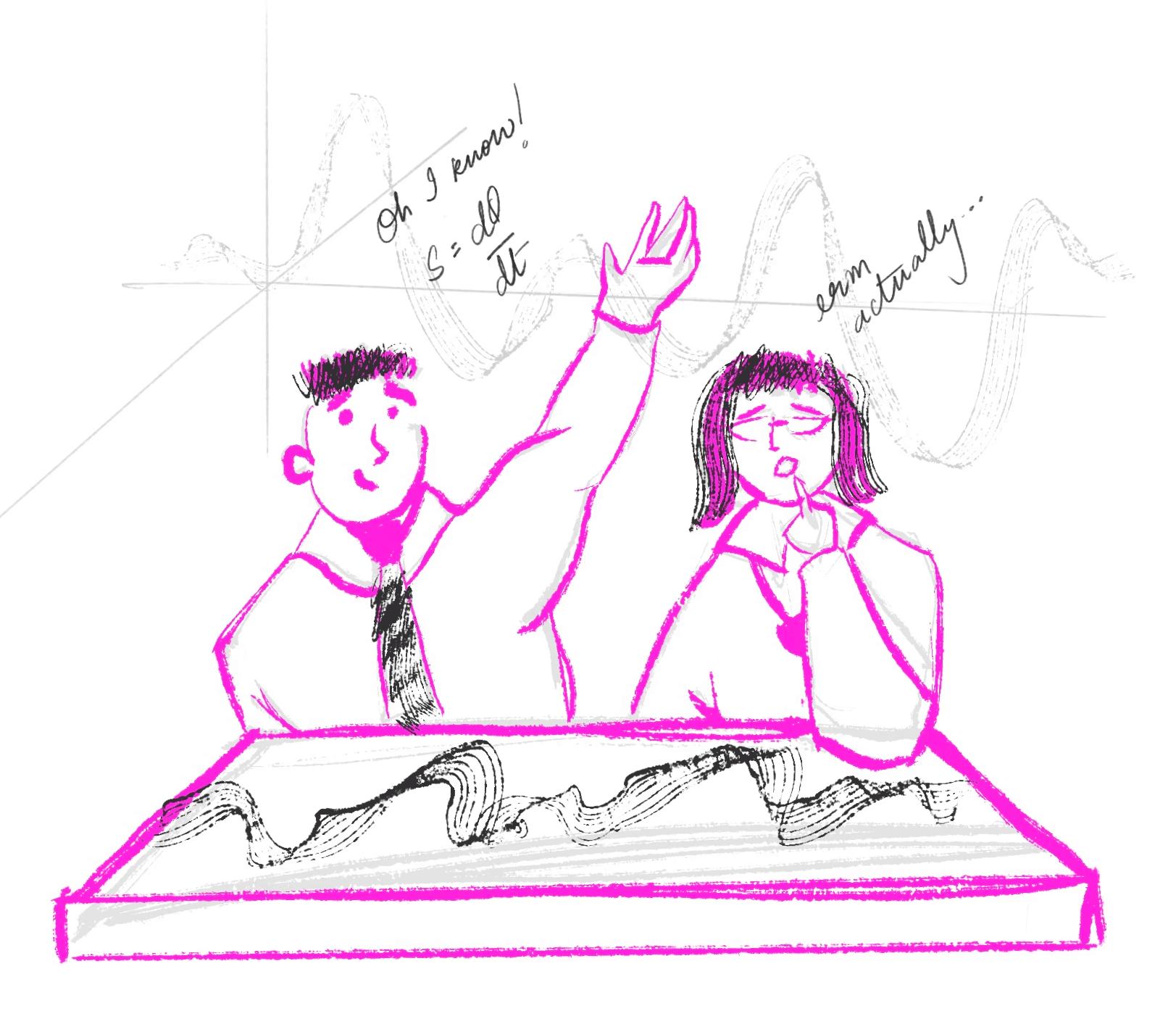
Let’s break down a classroom environment. Our star cast today includes our dear Ms Usha, who teaches the class maths; her straight-A student Mira; and the backbencher Ajay. Ms Usha catches Ajay making a 6-7 joke in the middle of her lecture and angrily sits him next to Mira (she didn’t catch Mira holding in her laughter, but we’ll come to that later). What Ms Usha basically wants to accomplish here is making Ajay behave according to a certain way that is shown desirable in Mira. She expects to create a self-organising system by sitting them together, one which makes Ajay a good kid and ensures Mira doesn’t lose her brilliance. Is this feat scientifically achievable, though?
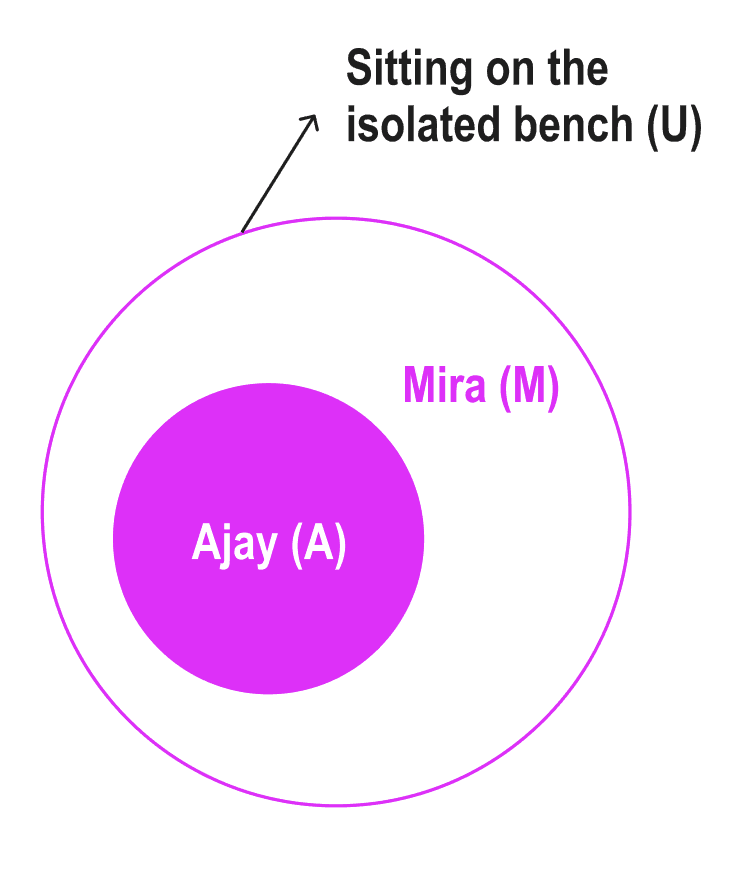
Let’s assume their bench to be our universe (U) and Ajay (A) as the system which has to be self-organised and Mira (M) as the environment on which he’s dependent. Let’s also assume that their bench is completely isolated, creating adiabatic conditions, ensuring that there is no interaction between A and M with anyone else. Now here, we can use ‘naughty’ as analogous to entropy, or the measure of disorder or randomness. Ms Usha would ideally want Ajay’s degree of 'naughtiness' or entropy to be minimum. Now we can write this as:
PART 1: Ajay weds Mira
written in may 2026
The women in my life and I have often joked about how during our formative years in school, we were often sat next to the seemingly ‘notorious’ kids or backbenchers. The very research-backed, 100% success-rate-yielding rationale that we used to receive from our teachers was along the lines of, "They'll also learn to behave now!” As a kid I used to laugh it off and wonder what they would do if the other way round were to be true instead. What if the ‘rotten’ apple rots the ‘unrotten’ one? What ended up happening was just unexpected friendships. Interesting, I had never explored the physics, or rather the design of it, till now.

Where A[n] represents Ajay's naughtiness, M[n] shows Mira's naughtiness, and U(n) shows the combined naughtiness of the whole universe, which also becomes the initial naughtiness.
Now, if Ajay works a little while and asks Mira some questions, his naughtiness (A[n]) decreases during this time. This change in naughtiness, or entropy, can be expressed as the amount of energy (represented by Q) that was required by them in this interaction as:
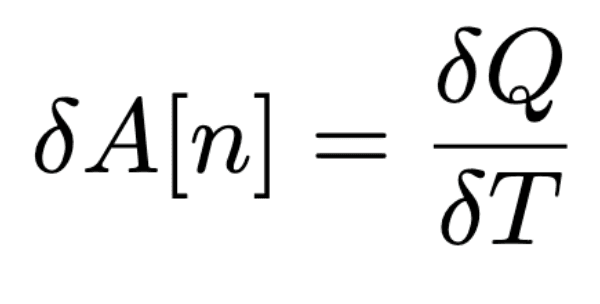
So since his naughtiness now is lower than before, we can write this as:
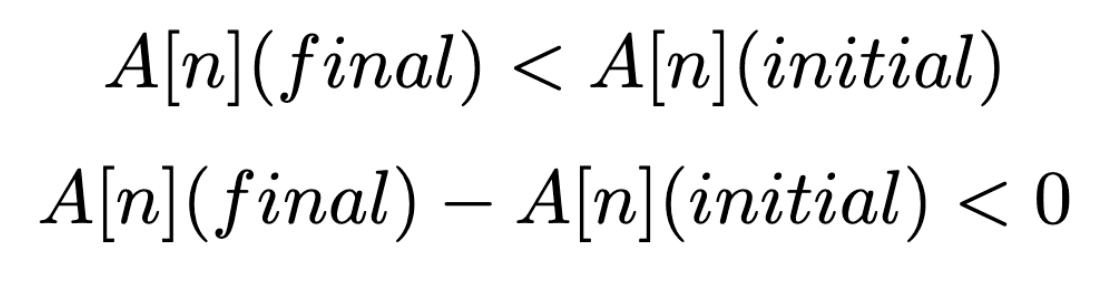
Make this over a long period of time and we get:
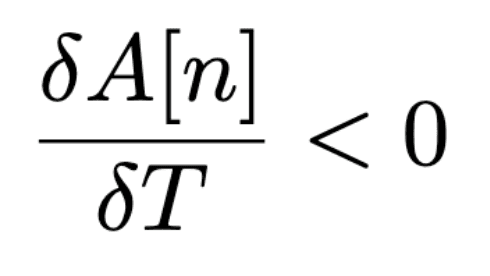
But wait, our 2nd law of thermodynamics says that things generally tend towards disorder (sorry, Ms Usha, we all tend to be naughty; Mira can just control really well, I guess).
Anyway, so that means the overall energy or entropy or naughtiness of the bench has to be conserved. So if A[n] decreased, then M[n] has to increase for our bench to have the overall same naughtiness as before.
But wait, wait, wait – the amount of time and energy that poor Mira spent trying to teach Ajay basic integrals is something that she cannot get back. She’s now tired and doesn’t feel like she can do maths for a while. Now this increases her naughtiness, and it makes this process irreversible. The amount of effort she put in to teach him was more than the amount he could actually retain since he was busy making brainrot references.
This means some processes (Mira being fatigued) in our universe U were irreversible, which has led to an overall increase in the naughtiness of the universe.
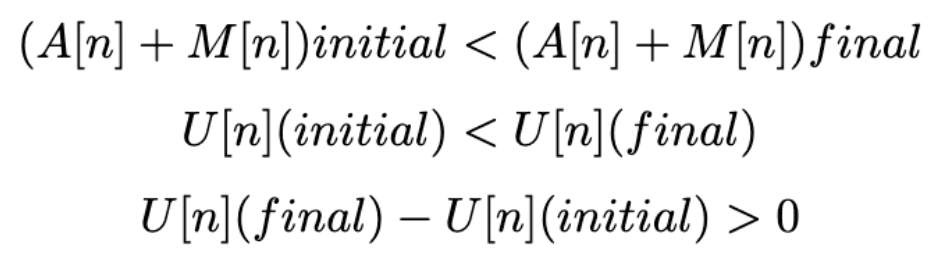
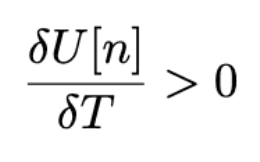
So we end up with an increased entropy of their entire bench. Since Mira is tired, she can't help Ajay anymore, and the system has thus become a disorganising system.
Hmm. Why are we considering them two different systems, though? What if they marry each other and combine? Sure, now let’s consider Ajay and Mira to be one single system, S, seated on an isolated bench again. But now, Mira is again going to be tired of the Salman Khan jokes and her entropy, or the entire system’s entropy will also increase, and with time the system will become even more disorganised. Yeah, yeah, Ms Usha Ajay is still learning a bit, and his naughtiness is decreasing, but you need to understand that this takes a toll on Mira, and this keeps going on perpetually (they better start paying Mira).
Ms Usha, please don’t resign yet; I know we just proved that you can never expect Ajay to become your ideal student Mira without Mira being superhuman.
Oh wait, what if Mira becomes superhuman with infinite intelligence? Would a self-organising system be possible then? Theoretically, yes! As long as Ajay and Mira are in a constant state of perpetual learning and teaching and somehow manage to stay in that state without external disturbance, then yes! So Mira needs to constantly learn something from Usha, and then Ajay has to keep learning from Mira.
So it doesn’t mean Ajay wasn’t good enough to become smart, but we weren’t smart enough to exchange our smartness. Well, maybe it could work if Ajay is sat next to Einstein or that one uncle we meet at weddings with unparalleled intellect.
PART 2: The monitors are going to write your names.
Ms Usha is so disappointed in Mira by this point that she takes Mira's monitor duties away and appoints Parul and Yuvraj as the new monitors.
Now Ms Usha sits everyone in the class in pairs, similar to Ajay and Mira. Let's say the entropy of the entire class is C, and C(max) gives us the maximum naughtiness that the entire class can have together. Ms Usha has left the class for an important meeting, and it's up to Parul and Yuvraj to handle things now. But wait, what is even considered naughty enough for their names to be reported? Dropping a water bottle in a quiet class causes disturbance, but so does starting a fight even though they can have different magnitudes of disruption. To account for this relative aspect, we can define a relative entropy of the class as a ratio of C and Cmax.
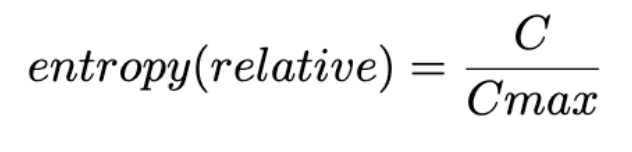
We also know that the disruption in the class can have two extreme values, being in a state of either maximum chaos or pin-drop silence. So we can say that this measure of peace and quiet will definitively lie between 0 and 1, where 0 represents complete peace and 1 represents complete chaos. From this we observe the redundancy (R) in this chaotic behaviour among certain students, and we can obtain a relation as follows:
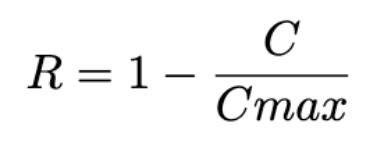
This means when the class reaches maximum chaos (C = Cmax), then R = 0, which means all the benches are behaving in a different chaotic manner with no redundancy. If, say, Parul and Yuvraj are able to control the most chaotic bench, then all the other benches might get influenced by it, and the class will be in a state of perfect order (C = 0), resulting in R = 1 and the students behaving similarly.
We know that for the class to be self-organising, the change in entropy will have to be as low as possible, and hence the change in the redundancy will have to be greater than 0 (the higher the redundancy or similar behaviour among the students, the more likely they are to be quiet). You might think, 'Oh! But what if they are all shouting? Wouldn't it be more chaotic then?' But then if they are truly similar, Parul and Yuvraj calming one bench also will affect all the others.
Differentiating the equation of R on both sides with respect to time, we get:

Since we can't let Cmax be 0 (you can't divide by 0), it'll be same to assume that the class isn't already completely quiet. So Cmax^2 is always going to be a positive quantity. Now we know that,
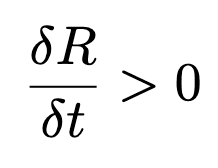
So putting this inequality in the previous equation, we get:
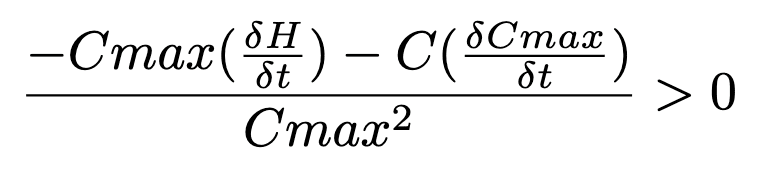
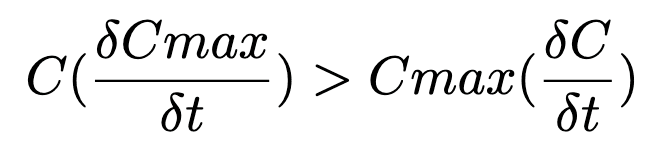
Now let's consider two cases:
First, if the maximum chaos in the class becomes constant and doesn't keep changing over time, then we'll obtain the following:
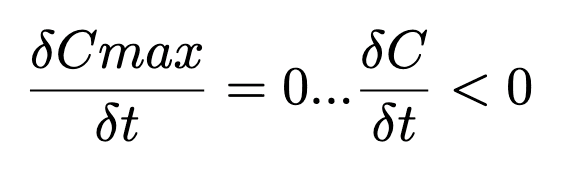
So as time passes, the chaos in the class will decrease, well, kind of. This chaos is dependent on the students' personalities also. If a student wants to complete their homework in class, they might not partake in the chaos; if a student feels bad about creating noise and disturbing others, he might quiet down after a bit. Let's assign Parul (P) the job to take care of these personalities, which makes them more or less likely to behave (she knows how to deal with Rohan's and Tara's shenanigans; it's not her first rodeo).
Now, for the second case, if the current entropy of the class becomes constant (everyone just keeps shouting at a steady pace), then we'll obtain the following:
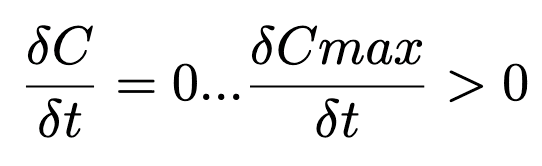
Shit, man, as time passes, the maximum entropy of the class keeps increasing. These kids are really outdoing themselves; the noise of so many students shouting together is definitely going to reach the principal. This means the number of students in the class (N) has a logarithmic relation with the maximum chaos caused in the class. This can be written as:

Where C1 and C2 are constants that we don't have to worry about. This clearly means having more students increases the capacity of the class to create more noise (entropy needs to be maximum). But we also know that for a self-organising class, the maximum entropy has to increase.
Isn't this counterintuitive? You're telling me that adding more students to the class will make the class eventually quiet down? How does that work?
Well, you see, we can't just let anyone enter the class and only those who have a similar property as the students already present in the class. So if Lalit was in the washroom when Ms Usha left, he can come back in, but we can't allow Rekha from 7th grade, who is coming to ask for an extra duster. That will cause more chaos, but Lalit being back in class would actually make the overall class more organised. So let's assign this duty or ensuring random students don't enter into the class to Yuvraj.
Parul is doing her best trying to individually deal with students, and Yuvraj is trying to catch the students bunking the class. Now for Yuvraj, if the size of the class is huge, say 100 students, then even if he makes a mistake and a random student joins the class (N=101), the chaos will increase, but that's still not a big deal as compared to a class with 5 students where even an addition of one student can be very disruptive.
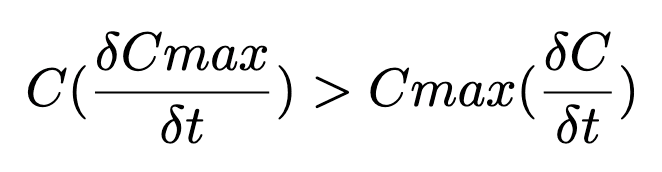
Similarly, if the maximum capacity of the class to create chaos is very high because of 2-3 extremely noisy students, she wouldn't have to deal with all the students together and could focus on quieting down those two specifically. If Yuvraj does a great job, Parul can focus on keeping the class quiet, and if Parul does that well, Yuvraj can focus on his work better. We can clearly see that the product of their efforts and results is having a consequence on each other's efforts and results.
Parul's results
Yuvraj's efforts
Yuvraj's results
Parul's efforts
Clearly, Parul and Yuvraj are interdependent on each other's competencies. When Parul is dealing with the naughty ones, Yuvraj can afford to be a little lazy. But if he's lazy for too long, Parul won't be able to cope with all the new students creating chaos and leading to a disorganised system.
Well. Ms Usha is back, and what she sees is definitely not a self-organising system that she intended, but hey, you know what? It was close enough! The kids respect Ms Usha enough to not shout her ears off. Shoutout to Parul and Yuvraj for not losing their minds and Ajay and Mira for trying.
Note: The above illustration was inspired by Heinz Von Foerster's proof of non-existence of self-organising systems, and it has been overly simplified and works in lieu of Heisenberg's Uncertainty Principle, which says we can either see a student or see how much chaos he's creating. Clearly we are humans and not subatomic particles, so this is intended to be just a fun, analogous exploration.